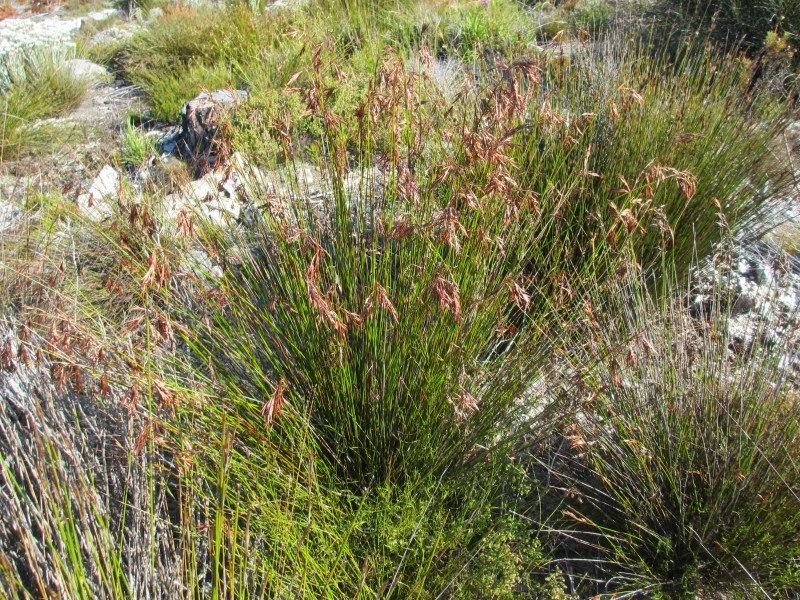
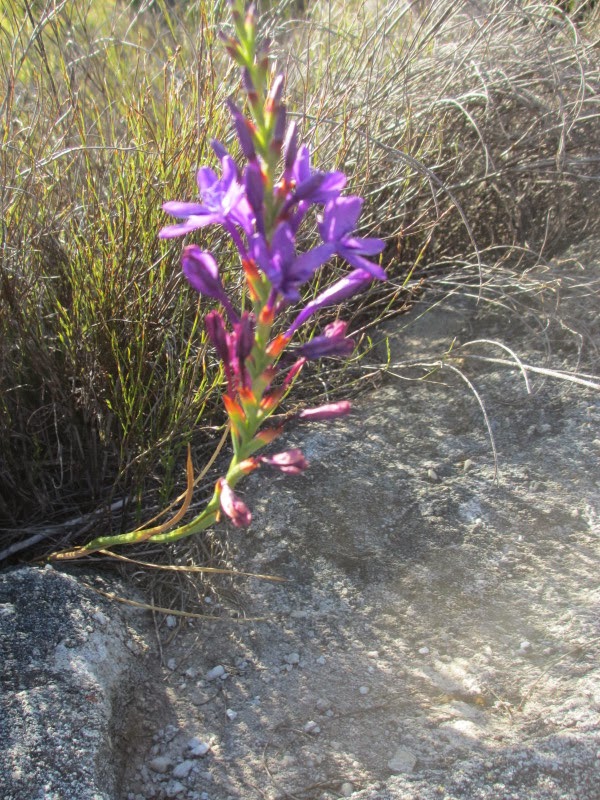
For inf! A
It appears the plant you saw is a Merciera and there are two or more. These look most like the azurea or the tenuifolia. Interestingly both share the same category on the Red List as VU (vulnerable) D2 (dunno what that means yet).
It appears that in the flower, the difference is in the length and shape of the 'stem' of the flower (behind the petals, I see it's called a 'corolla tube'. Thought that was a car!). One is funnel-shape or tapered, the other thin and straight (cylindrical). The photos sent in to i-spot are not confident in their classification, even well known botanists say 'it might be that'!
Regarding the leaves, on the tenuifolia there are 'tufts of small leaves in the leaf axils'.
There's even another Merciera eckloniana (slender tubebell) which 'is a more slender species with scattered leaves' (compared with what, I ask?). Red data status LC 'least concern')
All are members of the campanula group / family (dunno which is the right word), as are the Roella!
Merciera comprises six species, all restricted to the Cape Floristic Region.
Where is the plant and is it safe? It would be good for you or me to take more detailed pictures. Certainly your pic shows in places a long slender stem to the flower. Pippa calls for a Full Environmental Report! Well spotted!
This is an interesting subject! :-) A
| ||
Wednesday, 15 January 2014
Merciera
Saturday, 11 January 2014
Sunday on Saturday again....
.... or what's flowering here at the moment!
At the dam on the Experimental Farm, the indigenous Nymphaea nouchali (Blue waterlily)
Blondie, the hitch-hiker, aka Yablonya went out to check it out!
an interesting tiny white puff-ball fungus growing amongst the kikuyu:
As expected, the Roellas are impressive with lots of flowers out together!
An Erica:
The same one:
Another:
We were concerned that this well established one might get damaged with the clearing of the pines. We've been watching it for years but needn't have worried! Erica vestita?
There are so many different ones you really need to take an Erica book with you! This looks the same as the first:
Another!
So often overlooked, yet the books say in any Fynbos area, you'll always find Restios. Again you need a book on the subject! Erect:
Pendulous:
And something in between:
I am now convinced that the Lobelia add a sprinkling of blue to the veld throughout they year!
We hadn't checked on 'our' Leucospermum oleifolium next to the cycle track in the forest for a long time. The spent flowers which we watched develop for so long, certainly are pincushions. The three-tipped leaves are characteristic:
But what was exciting was the new growth; the flowers used to be on the tips!
Most impressive and prolific at the moment are the Watsonia schlechteri! Eikenhof Dam and our Country Club in the background; the water alive with Rowers!
Lots more to come!
The Agapanthus walshii flowers are opening nicely!
We've been trying to pin this yellow Iris type down for a long time:
Behind it, and not the only one we saw, was a Therianthus:
'Our' single example of a pink Helichrysum:
The little pink flowers amongst the fluff of the Lanaria lanata, with pollen on the anthers:
And two bright green bugs on a huge Pseudo selago serrata flower:
That should keep us happy for a week!
:-) A
| ||
Labels:
Agapanthus,
Erica,
Helichrysums,
Lanaria,
Leucospermum,
Lobelia,
Nymphea,
Restio,
Roella,
Selago,
Therianthus,
Watsonia
Location:
Grabouw, South Africa
Saturday, 4 January 2014
Sunday walk on Saturday
Always surprises! A different route, and on Saturday, because of dire weather warnings for tomorrow, although the promised 25mm is more like 2.5mm on the forecast now!
Only last week we remarked on the lack of tortoises, so I was very pleased to spot this one, who soon showed me a clean pair of heels!
Yes, as expected, the plant about to flower we've been watching for a couple of weeks, is a Roella. If every tip makes a flower, then it will be impressive soon!
Back to where the Drosera were, I really don't know what's what. The little red stems from last week seem to have branched out and become green, but what are these tiny flowers?
There were some big flowers on some of the Pseudo selago serratas:
Living up to their common name of purple powder puff:
And if you look carefully, there are still plenty of the small pink flowers on the Lanaria lanata:
We just had to go off the road to inspect this Mesemb, with its last few flowers, recently exposed by clearing of pines:
We remember from last year that there were plenty of Ericas from the beginning of the year, in fact they haven't really stopped.
Very different from last week's Many Umbrellas!
And the first of the upright types, in bud still:
The big surprise I spotted a long way off:
We think this is Watsonia schlechteri
This meant quite a walk off the road, and brought me close to the Agapanthus walshii, which luckily escaped damage with the recent pine-clearing, seen pushing up one bud a few weeks ago:
There's another flower coming, too:
Also in that area were Therianthus too:
Outside the farm during the week an irrigation pipe was being repaired and I took this shot of Acanthus mollis growing wild. It doesn't look like it but I couldn't reach the tips of the flowers from the ground!
Then on the way home yesterday evening, this Jackal Buzzard posed for me, while it pondered what had happened to the telephone lines:
:-) A
| ||
Labels:
Agapanthus,
Drosera,
Erica,
Lanaria,
Mesembryanthemum,
Roella,
Selago,
Therianthus,
Tortoise,
Watsonia
Location:
Grabouw, South Africa
Monday, 30 December 2013
Yesterday was Sunday!
We did more or less the same walk as last week, particularly to see the Therianthus:
This below is the first we noticed last week, and I'm holding a single strap-like leaf:
All the others seemed to have reed-type leaves. So what are they, spicatus or bracteolatus? One thing is for sure, having watched a single specimen for a full year now, once the flowers have gone, there's only the spent flower to show it's not just another tuft of grass!
Otherwise we were drawn to this Pelargonium:
The Lanaria lanata is mostly fully open, and the little pink flowers amongst the fluff seem to be past it:
This is definitely Micranthus corner! We had a hitch-hiker on the walk:
I tried three times to take a photo of this Pseudo selago serrata or Purple Powderpuff, but the wind was too strong, even holding the stem!
These Helichrysums have now fully dark red centres, which will go black later:
We are hoping these are Roella, if not, we're watching it!
The pinkness of this Leucadendron is more noticeable in real life than in the photo!
These were growing in the damp sand where we found the Drosera before, they're perhaps 40 to 50mm tall, any ideas?
But on the left above, one can see tiny flowers on a single stem:
I just couldn't get the camera to focus on the flower and the wind was blowing, but it looks like a sunny-side-up fried egg, but possibly only 3mm across! Any ideas?
Nearby, also in wet ground there was an Erica with interesting spherical or urn-shaped flowers:
Probably Erica multumbellifera.
The deep reddish colour of the Brunia flowers is looking impressive amongst the foliage!
Well, more questions than answers!
Finally at home, a female Sunbird was 'working through' the Wilde Dagga:
She has the right beak for the job!
Have a Great New Year!
:-) A
|
Labels:
Brunia,
Drosera,
Erica,
Helichrysums,
Lanaria,
Leonotis,
Leucadendron,
Micranthus,
Pelargonium,
Roella,
Selago,
Therianthus
Location:
Grabouw, South Africa
Subscribe to:
Posts (Atom)