Sunday, 16 November 2014

Pink Gladiolus Sunday Flower Walk Part 2

  
Part 2:
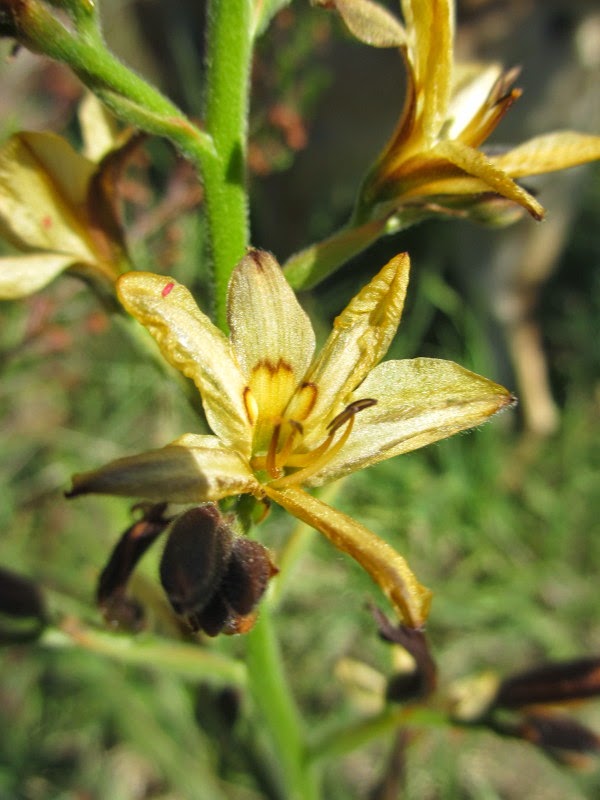
We expected the Dilatris pillansii to be all over, but we were happy to see some of those we had found before, still in flower:

Dilatris pillansii

But some have changed to a brownish colour:

Dilatris pillansii spent flower

The Star Grass Ficinia radiata has lost nothing in the last few weeks in looks!

Star Grass Ficinia radiata

Pippa spotted another splash of pink growing through a felled pine:

Gladiolus under felled pine

It's right next to the cycle path, so we decided to leave the tree as it is.

Flower detail

The Purple Powder Puffs Pseudoselago serrata are about to come out! We've been watching the plants all over, growing healthily, so we'll soon have impressive splashes of purple in the veld!

Pseudoselago serrata bud

The Wachendorfia paniculata aren't over yet!

Mass of Wachendorfia paniculata

If every pod has three seeds (there may be more?) then there are a lot of seeds from one plant!

Single Wachendorfia paniculata 

We're monitoring the endangered Agapanthus walshii plants we have found, particularly those which we know which have flowered in the past. We were pleased to find buds, one on this plant:

Agapanthus walshii with bud

.... and two on this one!

Agapanthus walshii with buds

Right across the road from the Aggies, I spotted a splash of mauve. I thought it might be an Erica, but something looked wrong. 

Lobelia jasionoides

The flowers, and on closer inspection, the leaves were all wrong!

Lobelia jasionoides flower and leaves

Lobelia jasionoides, which we have found up there before, but never a dense stand like this!

Lobelia jasionoides flower detail

I stopped to photograph the Campylostachys cernua which is growing right in the middle of the road, to see if there was any sign of a flower, but I think we have to wait until January or February!

Campylostachys cernua

Near it, also on the middelmannetjie, I spotted a splash of blue, thinking it was a Roella:

Unknown plant with open and spent flower

One flower, one spent. Narrow hairy leaves, close to the stem. Flower, close up:

Flower detail inside

What can it be?

Flower from the side

We always check the place where we found our very first Therianthus. The following year there were hundreds. Here the first one has pushed up a bud again!

Therianthus bud (right)

By this time, walking back on the road, we thought we'd had a 'good haul' for the day, but at the same moment both of us spotted more Dilatris pillansii on the other side of the road! I counted 11 separate plants and many were still in full bloom!

More Dilatris pillansii!

There are still many yellow daisies out, the ones we think are Euryops, but sometimes a splash of yellow looks out of place amongst them. This one made me walk off the road:

Unknown pea-type

A pea-type, growing close to the ground with roundish almost succulent leaves.

Flower and leaf detail

But that wasn't the end of it! A short way further, another pea, also yellow, but a totally different plant!

A different pea-type!

Flower detail. Which of the many Fabacaea are they?

Flower detail

What continues to astonish us is that until recently, this area had been completely covered by Pines for the last 100 years. Nobody has re-planted any of this!
While we were up there a train came past. This week I'll attend a meeting which will be one of the steps required to hopefully reinstate a passenger service on the line!

Grain train, one day passengers again? 

:-) A


This email is free from viruses and malware because avast! Antivirus protection is active.

Pink Gladiolus Sunday Flower Walk Part 1

Two full weekends on the trot Milling at Compagnes Drift Water-mill are my excuses for the long gap since the last report!
Today, Blondie aka. Yablonya or Scratch Patch, the neighbour's Labrador who comes to play, is hobbling so we didn't go far. But wait till you see what we saw in about two kilometres!
Just beyond the Railway cottage ruins we were assailed by the dead smell of Helichrysum foetida which grow in profusion there. You don't get any closer than this:

Helichrysum foetida

From the bad smells to the good ones! This Buchu Agathosma betulina has an exquisite smell if you rub its leaves. It was badly broken away last year, so we pruned back the shoots which died back and it has recovered nicely. We're watching the progress of its babies all around!

Agathosma betulina

But to the title of this report, we wanted to get back to the large stand of pink Gladiolus we spotted last time, and as expected, most of the flowers were spent:

Spent flowers of Gladiolus carneus (?)

These flowers, almost over were from a separate plant. One could so easily walk past this plant without flowers and take it to be yet another clump of Paspallum grass. The leaves are not much wider than that, about 6mm at the widest. Jessie wants us to capture some seeds of this one, so we inspected the pod development:

Seed pods of Gladiolus carneus (?)

I suspect they must mature on the plant and we plan to take a panti-hose up next time and tie it around one of the many stalks. Mike thinks this is Gladiolus carneus. This is how the spent flowers are arranged on the stalk:

Growing pattern of this Gladiolus

But we were itching to see the other, very different one growing on the other side of the road, which looked so promising last time and which we have been watching all year. We were worried it might have come and gone in these last three weeks, but we were not disappointed! From the top it can be seen that the plant grows out of the ground in an Iris type fan, the leaves are wide and pleated and the flowers are tightly arranged along the stem. Very different from the plant we had just seen!

Gladiolus pappei (?)

Flower detail. Mike reckons this is probably Gladiolus pappei:

Flower detail of Gladiolus pappei (?)

Elated, we walked on, staying off the road, eyes peeled! There are masses of Pelargoniums in flower; at this level the flowers are almost white with red veined markings:

Pelargonium flowers

It was nice to see big fat berries on the Teedia we had seen flowering. We remember PT = Pink, Teedia; WO = White, Oftia. They are difficult to tell apart the rest of the year!

Teedia berries

Lanaria lanata are making their cotton-like balls of fluff, but there is no sign yet of the tiny pink flowers which are seen later in the fluff.

Lanaria lanata

For the record, the Lobelia are still flowering, this one we think is L. tomentosa:

Lobelia tomentosa flowers


It wasn't long before I spotted some more pink!

Another Gladiolus carneus?

This was again one of those with the finer leaves, G. carneus?

Growing pattern

And standing up from taking that photo, even more!

More!


Here I had the opportunity to take photos of the flowers to compare, while Pippa sketched.

Flower detail

It's difficult to tell the two flowers apart (to a mechanic, anyway!), but the way the plant grows is very different, and these have a reddish base to the leaves.

Leaf detail, red at base

The Helichrysums are coming into their own. The pink centres of these Cape Snow Syncarpha vestita are already changing to a dark red and soon they'll be black:

Cape Snow Syncarpha vestita

This plant is proving to be difficult to pin down. Most are past their best, but this one stood out:

Unknown flower

Flower detail:

Flower detail

More in Part 2!


Sunday, 26 October 2014

Short Sunday Flower Walk

Short, because the dogs ran after a buck and the neighbour's Labrador didn't come back to us. We were worried and searched the area they disappeared into. We should have known she was waiting here at (our) home for us!

It didn't stop us from seeing plenty anyway, starting with a pair of Orchids this morning, growing in the rotten stump of a tree down by the river where we've cleared the bush. What made me take the picture was the ball of foam at the base of each:

Two Orchids with foam on their stems

In the band of Municipal ground along the Klip River next to the Bins family property, where it was until recently completely overgrown with Black Wattle and Port Jackson, there is now a lovely grove (albeit still under a canopy of Black Wattle) with these Arum Lilies Zantedeschia aethiopica.

Arum Lilies Zantedeschia aethiopica

Next step is to plant indigenous trees to consolidate the banks and when they're established, to cut the wattles down. The general appearance is very appealing, the river is much cleaner and from here, all I could smell was my apple blossom from the other side. Quite a change!

Klip River between the Bins' and our Dunland orchard

We have now read that there are four distinct kinds of Wachendorfia paniculata, which might explain the different flowering times and leaf shapes we have noticed. These are on the bank of the dam on the Experimental Farm next door.

Wachendorfia paniculata

The branches on the flower stalk are comparatively short. This is what the flower looks like, and they're in full bloom now. The patches on the upper petals are pale:

Wachendorfia paniculata flower

... and the leaves are narrow and soft:

Wachendorfia paniculata leaf

Compare these to the ones we found flowering in the lower areas just beyond the railway line. The seed pods are orange already and the leaves are drying up:

Wachendorfia paniculata seed pods

Then further up, the largest of them all

Larger Wachendorfia paniculata

The branches on the flowering stems are longer. Detail of the flower with black patches on the upper petals:

Flower detail of large Wachendorfia paniculata

... and the leaves are stiffer and wider. Somehow we must unravel which is which, but one thing is for sure, they're spreading throughout the whole valley!

Stronger leaf

Back to the bank of the dam, there is a striking pink Erica which I have photographed before. It's still a mass of flowers, so today I got up close. The relatively shallow flowers look square:

Erica with 'square' flowers

Not sure what this pea-type flower is, but it grows wild on the bank!

Pea type flower

Some previous occupant of the Railway Foreman's house at the must have been a keen gardener. This Geranium / Pelargonium is growing amongst the ruins:

Geranium/Pelargonium at Railway cottages

Also on the edge of that garden is this Prickly Pear Opuntia which is covered in buds which will shortly make an impressive display. Ever wondered where the name comes from? Wiki has the answer: The genus is named for the Ancient Greek city of Opus, where, according to Theophrastus, an edible plant grew which could be propagated by rooting its leaves.

Buds on prickly Pear Opuntia

Another pea-type with tiny flowers is growing along the path, perhaps a Tar Pea Bolusafra bituminosa like we've found before, higher up?

Another pea, Tar pea Bolusafra bituminosa

The leaves are hairy:

Hairy leaves

The Sparaxis bulbifera have finished flowering and there's a good crop of seeds for next year!

Sparaxis bulbifera seed pods

While searching for the missing dogs, Pippa spotted a splash of pink!

Gladiolus

It's well hidden behind bushes, the flowers are beautiful! A Gladiolus?

Flower detail!

All year we've been watching this completely different plant which we thought might be Gladiolus carnea not far away, which also gave us a pink flower like this. First there was one leaf, then another, now several and what looks as though it might be the beginning of a flower stem at last!

Gladiolus carneus (?) spotted last year, with flower stem appearing

This is the first Lanaria lanata we've seen this year:

First Lanaria lanata bud

There's also a good crop of seeds on the Trachyandra revoluta plants we've found in one place only:

Trachyandra revoluta seed pods

Look carefully in the middle.....

Caterpillar on Trachyandra revoluta

The two Dilatris pillansii plants we found are looking even better than last week!

Dilatris pillansii

Flower detail:

Dilatris pillansii flower

Near it, the Star Grass Ficinia radiata was difficult to miss, but there was no sign at all of the lilac flowers in amongst the grass tufts which we saw last week!

Star Grass Ficinia radiata

Finally, this tuft of grass was worth going off the road for!

Unknown grass

:-) A