Two weekends milling Stone-ground Meal at Beaumont Wines / Compagnes Drift in Bot River as part of Elgin Open Gardens, means it's been three weeks since we had a proper Flower Walk! There were some exciting surprises in store for us! But first a few things seen in the past weeks, first a beautiful white Pelargonium, possibly P. suburbanum spp bipinnatifidum on a farm here:
 |
Pelargonium suburbanum spp bipinnatifidum?
|
In a flower pot in our garden, we suddenly found a Salsify growing, the spent flower looks more impressive than the flower itself! There are many more flowers behind, waiting to open, when they decide the time is right!
 |
Salsify seed head
|
On the same farm as the Pelargonium, there are many of these pink Watsonias, possibly W. borbonica ssp ardernii:
 |
Watsonia borbonica spp ardernii?
|
On the side of the road, I spotted this. Could it be a Pink Chink, a kind of Ornithogalum?
 |
Ornithogalum?
|
The whole plant looks like this:
 |
The whole plant, on the roadside
|
Back to today, we were delighted to see a flower on the Gladiolus carneus we have been watching (and had marked) since the fire, now exactly nine months ago. The leaves had been nibbled off by rabbits (we saw the spoor) and on one occasion the bulbs were scratched out of the ground (we covered them up again), so we were lucky to get anything at all!
 |
Gladiolus carneus
|
Last year there was a dense stand of them. We could find them after the fire because they were close to a strong bunch of Lanaria lanata. These were some of the first plants to come up after the fire and they are now more prolific than ever before! The little flowers are beginning to show in the cotton-buds:
 |
Lanaria lanata flowers
|
The Wachendorfia question is still foxing us! Here are the seed pods already orange on the plants with the curved leaves growing flat on the ground. The leaves have dried up completely:
 |
Wachendorfia, curled leaf growing on the ground, flowers gone to seed
|
Yet those we know as W. paniculata with the radiating leaves growing upwards, are now just starting to flower. Both are growing in areas equally burnt. These will be stunning in a couple of weeks!
 |
Wachendorfia paniculata, just starting to flower
|
Flower, up close:
 |
Wachendorfia paniculata flower
|
The Trachyandra divaricata have set masses of seed pods. I have read they are hardy and are useful in binding dunes. Their shoe-lace type leaves are still green below.
 |
Trachyandra divaricata, gone to seed
|
These Stargrass Ficinia radiata have never been so impressive, they seem to have appreciated the fire!
 |
Stargrass, Ficinia radiata
|
Flower up close:
 |
Ficinia radiata flower
|
I remember finding these Daisies before, in just one place. All the others seem to be yellow only:
 |
Unidentified Daisy
|
Here the flower is from behind, apparently important for identification:
 |
Flower from the back
|
All on its own, this looks like a Mimetes or a Leucadendron?
 |
Is this a Mimetes? A Leucadendron?
|
Three weeks ago, we were excited to find this bud on an Agapanthus walshii. It has grown about two feet since. We can't wait for it to open! The exciting thing is that we have never seen this stand of these ultra-rare plants (more can be seen in the background) before!
 |
Agapanthus walshii with tall bud
|
Here close by were at least five more buds. There are never many flowers on each stem and they get eaten by caterpillars and possibly birds, so very few actually get to make seeds.
 |
Several Agapanthus walshii buds
|
This Orchid made me stop and take a photo of it!
 |
Orchid
|
The consensus is that this is a kind of Pseudoselago. It is to be seen all over, having recovered after the fire better than ever before!
 |
Pseudoselago spuria?
|
Flower detail, Pseudosalago spuria?
 |
Close-up off the flowers
|
On the subject of Pseudoselagos, these Purple Powder Puffs P. serrata are about to open.
 |
Pseudoselago serrata, about to flower
|
This little pink pea has us stumped! There were quite a lot of them, here and there.
 |
Unknown pea
|
This is what the flowers and leaves look like, up close:
 |
Flower detail
|
We were making our way upwards to a hilltop, and came across this, growing out of the burnt remains of a Restio:
 |
Restio?
|
Many of the stems are curled and the fan-shaped flowers (?) at the ends were intriguing!
 |
Up close
|
The slope up there is carpeted with Lobelia jasionoides. Again we've never seen so many!
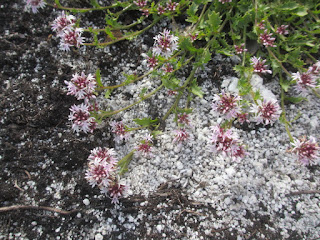 |
Lobelia jasionoides
|
At the top we wanted to see the 'babies' around the burnt Pagoda Flower Mimetes cucullatus. They are fighting for space:
 |
Mimetes cucullatus, growing from spread seed after the fire
|
Then on the way down, after months of watching, suddenly these plants with the rubbery leaves have burst into flower, giving us a clue to what they are. The closest we get is Lachenalia montana:
 |
Lachenalia montana?
|
Flower detail:
 |
Flower detail
|
The Bobartias are out! B. filiformis? This one is growing in a crack in the rock!
 |
Bobartia filiformis
|
Flower detail:
 |
Bobartia flower
|
What we were aiming for was what we thought last time was an Aristea:
 |
Aristea bakeri?
|
Here is the flower up close, Aristea bakeri seems to match the description best:
 |
Flower detail
|
We were very disappointed to see re-shooting under a burnt Protea cynaroides which had died off:
 |
Re-growth on Protea cynaroides died off
|
On the way back I went to see where I'd found the first of the rubbery leaves. I wasn't disappointed, they were all over the place! More Lachenalia montana:
 |
Lots more Lachenalias!
|
:-) A


