Showing posts with label Protea. Show all posts

Sunday, 29 January 2017

Almost all Blue Sunday Flower Walk

We've moved away from the yellows, and much of what we saw today was in various shades of blue, starting with the Roella ciliata:


They seem to be taller than the ones we remember from two years ago, before the big fire in this area. 

We always see Lobelias, those with the bright blue large flowers we think is L. tomentosa:


Although most are past their best, there are still Agapanthus walshii in flower:


This one below had us excited, was it the elusive white one? No, but a very pale blue:


It was pleasing to check that this one had been logged, finding my present position exactly the same as one marked 'AW Lower Rocky Ridge'. 

The deep blue of the Purple Powder Puff Pseudoselago serrata, after an impressive season, is nearly over.


There were even still a few flowers on occasional Psoralea pinnata:


Pinks, oranges and reds seemed to be the other colour of the day. Although many of these Watsonia schlechteri have gone to seed, there are still many in bud, so we'll be seeing them for a while yet.


Before the fire, we pinpointed what we thought were Erica obliqua. We have searched that location carefully since without success. About 100 metres away we have found a strong population, perhaps 20 plants so far, of what we hope is the same:


Welcome back!


Also pleasing to see in that vicinity, another old favourite (the Ericas seem to have recovered the slowest!) Erica pulchella:


We specially went back to look at a Protea-type which we've been watching for weeks now. Only one tiny flower opened in the middle of December, and we found it today, actually loose from the plant, but held in place by branches of new growth. We left it there, to mature fully and disperse seeds. 


There are about eight plants in a small area. The closest we get to identifying it from the books is Leucospermum bolusii, but if it is, it's way out of its area, supposed to be the slopes above Gordon's Bay. The tips of the new growth are pinkish:


What can it be?


It's nice to see the Brachylaena neriifolia in flower again! The shrubs have a lot of growing to do to reach the size of some of those which were burnt!


It's always nice to go home past the Prickly Pear Opuntia in the garden of the ruins of the Railway Foreman's house:


:-) Andy

Sunday, 18 December 2016

Agapanthus walshii are Out!

In the last few months we have logged every Agapanthus walshii plant or population we have found, recording GPS co-ordinates and giving them a name. Occasionally in my Fire duties in this sector, which is bigger than the area we walk normally, I have found and recorded more.


The most astonishing population is in an area which was completely forested and near a road we have walked on hundreds of times. If the plants had come up, flowers or not, we would have seen them. With the forest cut down and a fire almost two years ago, the population is the strongest we know of, and incidentally, has come into flower earliest!


This is only a part of this population. The exciting thing is that through doing nothing to those plants we know about, besides plotting them, we know they will survive the next 'crop' of pines now planted in this area, over the coming 20 or more years!


Immediately noticeable is how few flowers are in each bud.

In this immediate area we found for the first time a group of tiny Proteas.


Some have a single flower at the tip.


On others, it looks as if we will be treated to a bunch!


The Purple Powder-puff Pseudoselago serrata which we've been watching develop for months now, are in full flower, and will probably go on flowering for some weeks to come. The purple splashes in the veld are difficult to miss!


The 'puff' up close, as usual, with a bug:


We were walking along the dividing road between 'compartments' of new forest we call 'Therianthus', wondering whether the dry conditions will hold them back, and sure enough, we found some!


This particularly bright, and late-flowering Daisy caused me to get up close!


And on the way I found some Mesembryanthemums also still in flower.


Flower and spent flower detail:


The flowers on the Sour Figs Carpobrotus edulis are over, leaving interesting-looking fruit/seed pods:


Some of the pink-centred Helichrysums have turned black already!


A healthy stand of Rush Iris  Bobartia filiformis:


The Star Grass Ficinia have lost their bright yellow colour, but they are still impressive!


In places, there a good crop of berries on the Teedia (or Oftia?) plants!


We are not sure what this is, a Metalasia, perhaps?


Flowers up close:


We seem to have lost the few specimens of the tall Erica obliqua where we plotted them before the fire. Several hundred metres away, we have found several plants, now about to flower, which we hope might be more.


Bud detail:


:-) Andy
Sunday, 13 December 2015

Corymbium glabrum Sunday Flower Walk

There's always something interesting in the derelict garden of the railway cottages! At the moment it's a splendid stand of deep oraange Day Lilies growing amongst Acanthus mollis:

Day Lilies and Acanthus mollis in the derelict garden of the Railway Cottages

Today we went looking for a group of Watsonia schlechteri we remembered in the unburnt area just above the railway line.

Watsonia schlechteri

Then Pippa remembered there was a plant which we had never identified before, growing right there. Here is a bunch of spent flowers:

Aspalathus callosa

For the first time we've found flowers still on it, another yellow pea! Possibly Aspalathus callosa.

Flower detail

This gives an idea of the size of the plant, it must have been impressive with many of the flowers open!

Whole plant

We're sorry to have missed this little plant flowering.

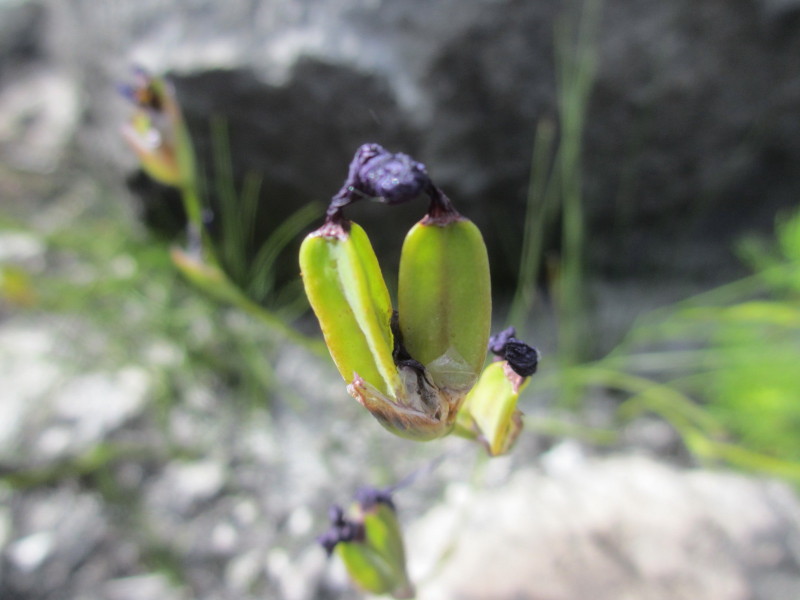
An Aristea

The spent flowers or seed pods looked familiar:

Spent flower up close

Later in the walk we looked at the Aristea bakeri we have been watching (below), and found very similar pods. Could this (above) be Aristea racemosa, or A. juncifolia? It was past 4pm so it might have flowered this morning.

Spent flowers of Aristea bakeri elsewhere

Our first Therianthus this year! Growing here amongst Pseudoselago spuria which have nearly finished flowering. On the right are more about to open.

First Therianthus!

Here was an interesting plant, easily overlooked, but I spotted tiny flowers on the tips.

Untidy red plant, lying down, with tiny pink flowers at the tips

Flower detail

Here is another plant, not so far advanced:

Les advanced plant, upright and greener

We were aiming for the stand of Agapanthus walshii we have been watching open gradually for a few weeks.

Agapanthus walshii

The way the flowers hang sets them apart.

Ten Agapanthus walshii flowers or buds on one plant!

We counted 45 buds or flowers in this small area. Not bad for an extremely rare plant!

Agapanthus walshii flowers

A little way on, while watching a pair of black crows, Pippa noticed a splash of deep pink. Corymbium glabrum var glabrum, unless there's another variety with this deeper pink.

Deep pink Corymbium

We were making for the Curlygrass fern Schizaea pectinata we had found before, to find the fans of the flowers more fully developed and greener than before:

Curlygrass Schizaea pectinata flowers up close

I spotted what I thought was yet another Purple Powder Puff Pseudoselago serrata, but this was growing too close to the ground. Close up it was something completely different!

This looks familiar, but we can't remember what it is! 

The flowers are deceptively long trumpets, and if you look carefully you can see long forked stamens coming out of some of the flowers. The closest we get is Merciera, but this grows too close to the ground for them.

Flower detail, long trumpets and longer stamens!

We found another Corymbium, further advanced and much paler than the previous one.

Paler Corymbium

Up there we found this Purple Powder Puff Pseudoselago serrata, definitely the biggest of the day!

The biggest Powder Puff we found today!

We wanted to check on the offspring of the burnt Pagoda flower Mimetes cucullatus which would have been in flower now. The babies are looking well!

Baby Mimetes cucullatus

These have clearly grown from seed scattered from the parent close by. Also in the Protea family, where we were disappointed that the re-growth we had seen at the bases of Protea cynaroides had shrivelled up, we are now finding seedlings close by:

Baby Protea cynaroides

What I thought last week was a Tar Pea Bolusafra bituminosa was identified by the experts as Rhynchosia because its leaves were in threes and pointed. This is more like it, with rounded leaves! We forgot to check if it was sticky!

Tar Pea Bolusafra bituminosa

It's late in the year to be finding Albuca. The latest in the books, up to November is A. cooperi, otherwise A. juncifolia would be a contender.

Albuca, but which one? 

The leaves look like this:

Albuca leaf

We stopped off at the Watsonia borbonica from last week, looking as good as before!

Watsonia borbonica

And near it a sea of Combflowers, Micranthus:

Combflowers Micranthus

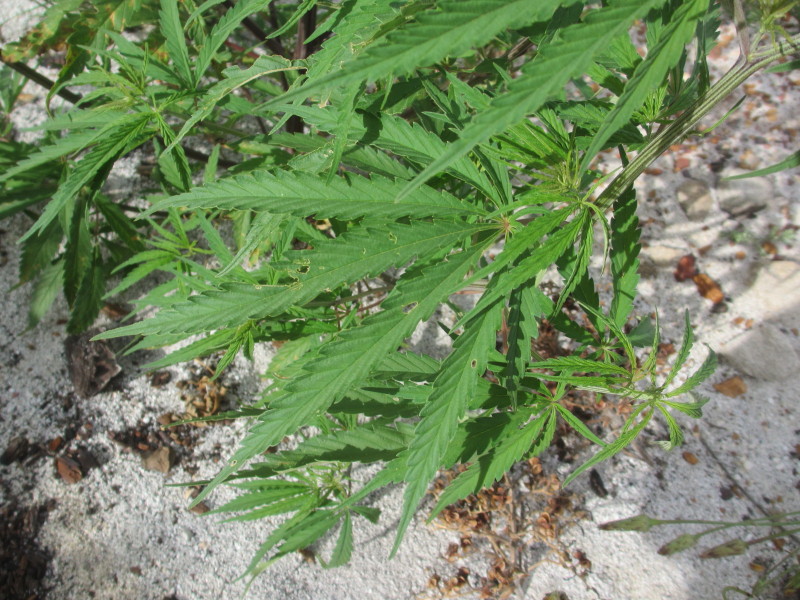
On the way back, this 'Weed' looked a bit out of place!

The 'Weed'

How did it get there?

Leaf detail

:-) A