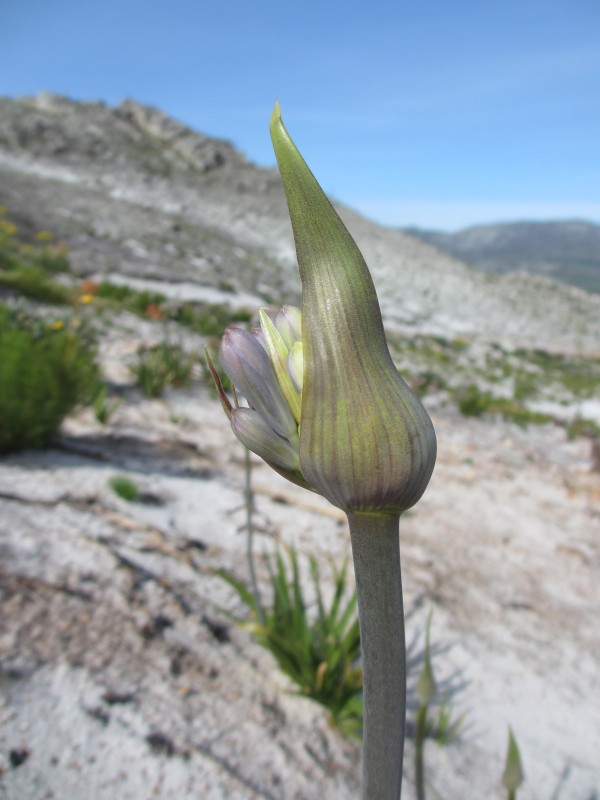
In the last few months we have logged every Agapanthus walshii plant or population we have found, recording GPS co-ordinates and giving them a name. Occasionally in my Fire duties in this sector, which is bigger than the area we walk normally, I have found and recorded more.
The most astonishing population is in an area which was completely forested and near a road we have walked on hundreds of times. If the plants had come up, flowers or not, we would have seen them. With the forest cut down and a fire almost two years ago, the population is the strongest we know of, and incidentally, has come into flower earliest!
This is only a part of this population. The exciting thing is that through doing nothing to those plants we know about, besides plotting them, we know they will survive the next 'crop' of pines now planted in this area, over the coming 20 or more years!
Immediately noticeable is how few flowers are in each bud.
In this immediate area we found for the first time a group of tiny Proteas.
Some have a single flower at the tip.
On others, it looks as if we will be treated to a bunch!
The Purple Powder-puff Pseudoselago serrata which we've been watching develop for months now, are in full flower, and will probably go on flowering for some weeks to come. The purple splashes in the veld are difficult to miss!
The 'puff' up close, as usual, with a bug:
We were walking along the dividing road between 'compartments' of new forest we call 'Therianthus', wondering whether the dry conditions will hold them back, and sure enough, we found some!
This particularly bright, and late-flowering Daisy caused me to get up close!
And on the way I found some Mesembryanthemums also still in flower.
Flower and spent flower detail:
The flowers on the Sour Figs Carpobrotus edulis are over, leaving interesting-looking fruit/seed pods:
Some of the pink-centred Helichrysums have turned black already!
A healthy stand of Rush Iris Bobartia filiformis:
The Star Grass Ficinia have lost their bright yellow colour, but they are still impressive!
In places, there a good crop of berries on the Teedia (or Oftia?) plants!
We are not sure what this is, a Metalasia, perhaps?
Flowers up close:
We seem to have lost the few specimens of the tall Erica obliqua where we plotted them before the fire. Several hundred metres away, we have found several plants, now about to flower, which we hope might be more.
Bud detail:
:-) Andy
Showing posts with label Oftia. Show all posts
Sunday, 18 December 2016
Sunday, 11 September 2016
Signs of Spring again!
Yes, the signs of another Spring are definitely here! Near the Railway cottages, our old favourite Geissorhiza aspera:
And along with them, Sparaxis bulbifera:
On the way up the hill we knew to watch on the left hand side at this time of the year for what we think is Trachyandra revoluta:
The tufts of boot-lace type leaves are getting thicker by the year!
In the wetter places, the Sundews, Drosera are to be found, but not putting up flower stalks yet!
Here and there we found Wachendorfia paniculata flowers, but they haven't come into their own yet. On the recently burnt areas near Villiersdorp the ground is carpeted with them!
The Daisy we think is Euryops starts by having one flower per plant for months, then suddenly they come out all over the plant!
Here's a huge flower!
We're never too sure whether these plants which have proliferated strongly since the fire of about 18 months ago, are Teedias or Oftias, until they flower. Pink for Teedia, white for Oftia?
On the subject of Trachyandra, we came across what we think might be another type while I was out with Forester Tommy Eckley on Friday. It must have been here all along, but we've never noticed it! We're having difficulty pinning down which it may be, with tough smooth leaves.
These Pelargoniums are at their best now!
The leaves are enormous in places!
Another old favourite, the Tar Pea Bolusafra bitumenosa:
Flower detail:
On a rocky outcrop we were looking out for this, Gladiolus debilis:
From there, an unusual view of the Eikenhof Dam, now full, without any pines around it! Our Country Club seems to have the only trees!
What we think is Pseudoselago spuria are out again. The flowers get longer and longer as they continue flowering through the season, then some plants die off, some seem to start flowering again.
Up there, the dogs found a swimming pool!
:-) Andy
Sunday, 29 November 2015
Corymbium Sunday Flower Walk
Last week we found Dilatris pillansii open, so when I found this plant, I thought it was 'the other' Dilatris, D. corymbosa:
Back home, something looked wrong, too few petals for a start.
There was a caterpillar on each bunch of flowers! Fernkloof's November list of flowers came to the rescue as usual, with Corymbium glabrus var. glabrus. I put it on iSpot and I have an agreement already! http://www.ispotnature.org/node/754928
The Fernkloof list helped last week with the identity of the blue flower we found on the side of the path, Cape Bluebell Wahlenbergia capensis. The flowers are all gone this week, and it took some careful searching to find the spent flowers today!
We were astonished at the size of the berries on this Oftia (or is it a Teedia?). This was in the unburnt area. It's pleasing to find new plants of one or the other coming up all over the burnt area. The berries are about 10 to 12mm in diameter and the plant was completely covered in them!
Lanaria lanata were some of the first leaves to come up after the fire, and many of them! They are looking magnificent at the moment!
You have to look carefully in all the fluff for the actual flowers!
Here's a Pea we remember growing here before. It has also re-grown completly since the fire, now 9½ months ago.
Flowers up close:
And a hitch-hiker:
This fungus was growing on a burnt pine stump:
And that brought us to a little Pelargonium with lemon-scented leaves! We've marked its position so we'll go back and see what the flowers look like.
The big Pelargoniums are about to burst into flower, the first few flowers are out:
We saw this amazing Wachendorfia from far away!
This bee was visiting every flower!
We were keen to check up on the development of the opening flowers on the 'new' stand of Agapanthus walshii:
Very satisfying! But you can see how few flowers are in each bud!
In the stand where before the fire there were twenty-something flowers, we counted 13 buds so far:
Another, all on its own:
There are still plenty of these that we think are Pseudoselago spuria to be seen, this one was alive with butterflies.
An isolated stand of a different Daisy:
The spent flower in the foreground above, looks like this:
And from the underside.... any ideas?
We're pretty certain these are Tar Peas, Bolusafra bituminosa:
These flowers are about 1.2 metres from the root of the plant:
The jury is still out whether these Lachenalia are L. montana:
How to photograph a Five Toothed Baboon Cabbage Othonna quinquedentata? Against the sky!
The flowers are so tiny compared with the rest of the plant!
Here's a Purple Powder Puff Pseudoselago serrata, one of the first of many, I'm sure!
:-) A
Subscribe to:
Posts (Atom)