Showing posts with label lanata. Show all posts

Sunday, 29 November 2015

Corymbium Sunday Flower Walk

Last week we found Dilatris pillansii open, so when I found this plant, I thought it was 'the other' Dilatris, D. corymbosa:

Corymbium glabrus var. glabrus

Back home, something looked wrong, too few petals for a start.

Caterpillar on flower

There was a caterpillar on each bunch of flowers! Fernkloof's November list of flowers came to the rescue as usual, with Corymbium glabrus var. glabrus. I put it on iSpot and I have an agreement already! http://www.ispotnature.org/node/754928
The Fernkloof list helped last week with the identity of the blue flower we found on the side of the path, Cape Bluebell Wahlenbergia capensis. The flowers are all gone this week, and it took some careful searching to find the spent flowers today!

Spent flower of Cape Bluebell Wahlenbergia capensis

We were astonished at the size of the berries on this Oftia (or is it a Teedia?). This was in the unburnt area. It's pleasing to find new plants of one or the other coming up all over the burnt area. The berries are about 10 to 12mm in diameter and the plant was completely covered in them!

Berries on Oftia or Teedia

Lanaria lanata were some of the first leaves to come up after the fire, and many of them! They are looking magnificent at the moment!

Lanaria lanata

You have to look carefully in all the fluff for the actual flowers!

Lanaria lanata flowers in the fluff

Here's a Pea we remember growing here before. It has also re-grown completly since the fire, now 9½ months ago.

Unknown Pea

Flowers up close:

Cluster of Pea flowers

And a hitch-hiker:

Ladybird on Pea

This fungus was growing on a burnt pine stump:

Fungus on burnt pine stump

And that brought us to a little Pelargonium with lemon-scented leaves! We've marked its position so we'll go back and see what the flowers look like.

Scented-leaf Pelargonium

The big Pelargoniums are about to burst into flower, the first few flowers are out:

First flowers open on the big Pelargoniums

We saw this amazing Wachendorfia from far away!

Magnificent stand of Wachendorfia paniculata

Flower up close

This bee was visiting every flower!

Flower with honey-bee

We were keen to check up on the development of the opening flowers on the 'new' stand of Agapanthus walshii:

Agapanthus walshii, just opening

Very satisfying! But you can see how few flowers are in each bud!
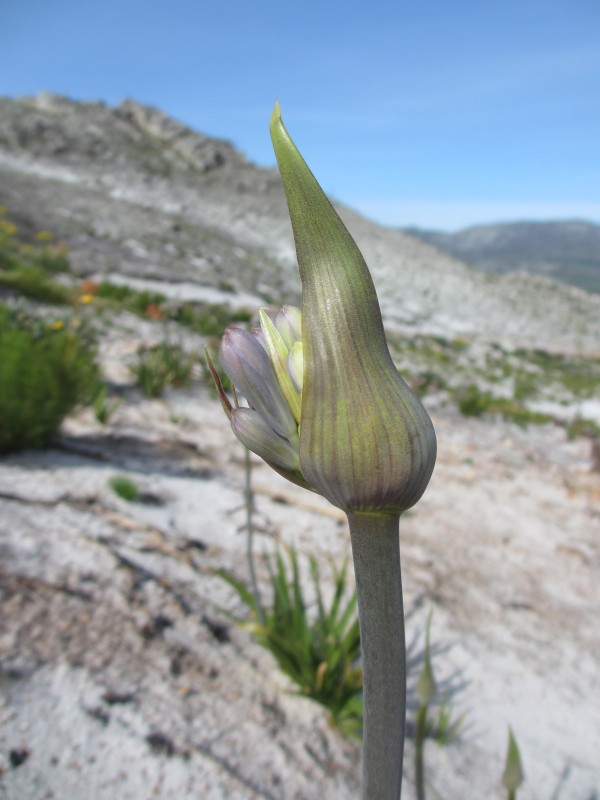
Another bud just opening

In the stand where before the fire there were twenty-something flowers, we counted 13 buds so far:

13 buds in this stand already!

Another, all on its own:

One on its own, with bud

There are still plenty of these that we think are Pseudoselago spuria to be seen, this one was alive with butterflies.

Pseudoselago spuria with butterflies!

An isolated stand of a different Daisy:

Unknown Daisy

The spent flower in the foreground above, looks like this:

Spent flower

And from the underside.... any ideas?

Flower from the back

We're pretty certain these are Tar Peas, Bolusafra bituminosa:

Tar Pea Bolusafra bituminosa

These flowers are about 1.2 metres from the root of the plant:

This Tar Pea has spread 1.2m from the root already!

The jury is still out whether these Lachenalia are L. montana:

Lachenalia montana? 

How to photograph a Five Toothed Baboon Cabbage Othonna quinquedentata? Against the sky!

Othonna quinquedentata, against the sky!

The flowers are so tiny compared with the rest of the plant!

... with its tiny flowers!

Here's a Purple Powder Puff Pseudoselago serrata, one of the first of many, I'm sure!

Pseudoselago serrata, Purple Powder Puff

:-) A


Monday, 7 September 2015

Early Sunday Flower Walk

I was busy all weekend stone-milling at Compagnes Drift as part of Bot River Spring Weekend, but we were keen to see if the Satyr Orchid had opened, so we went up early on Sunday morning. It's not open yet, but it is still impressive! Or are those lower flowers fully open?

Satyr Orchid

Flower detail:

Flower up close

There are ever more Wachendorfias open, but still only those with the sickle-shaped leaves growing on the ground.

Wachendorfia in full flower

There's still no sign of buds on the upright-growing ones.

Wachendorfia, no buds yet

We were pleased to see the return of the insect-feeding Drosera in the stony ground of the road.

Drosera

Finally we have open flowers on the Othonna heterophylla!

Othonna heterophylla

Flower detail:

Othonna heterophylla flower

A bud (with bugs ready to move in?):

Othonna heterophylla bud

We found another, a short distance away, with slightly different flowers. Maybe the petals will still curl back?

Othonna heterophylla flower on another plant

Here is a Baroe, Cyphia volubilis, with nothing to twine on to!

Baroe, Cyphia volubilis flowers

...... so it's continuing to grow in the hope of finding something!

Baroe, with long stalk

At last, the Lanaria lanata, after being one of the very first plants to re-grow, have buds on!

Lanaria lanata bud

Here is one which seems to have been deformed (by the fire?), the stems are siamesed.

Lanaria lanata with siamesed flower stalks

We almost forgot the plant with the strange long striped bud we found last week, so we back-tracked. It took some finding, but we have now marked its position.

Unknown plant

Some flowers seem to have opened and are spent. What could it be?

Flower detail

The Brunias are at their very best!

Brunia in full bloom

In the early morning the dam at the Experimental Farm made a pretty picture, reminding us that the area we are monitoring should be covered with Ericas!

Erica at the Experimental farm dam

:-) A


Sunday, 2 August 2015

Diverting Water Sunday Flower Walk

On the path past the Railway cottages there are little splashes of yellow from Romuleas, R. flava?

Romulea flava?

...and pink/mauve ones, R. cruciata? They have loooong thin leaves!

Romulea cruciata?

Also next to the path we can count on seeing Sour Fig Carpobrotus edulis, which are also slowly growing back in the burned area, if you look hard.

Sour Fig Carpobrotus edulis

We have been watching the main access road wash away year after year, all because a culvert is blocked, which should allow the water to follow its natural course. Instead, it is diverted by the road and goes straight down the hill, taking everything with it. I have been trying to dig it out both ends these last couple of weeks, but today I took some drain rods from the workshop.

Clearing out the culvert

I had made a temporary furrow across the road while I worked, but this shows the last of the water flowing along it, the rest is going through the culvert. When we came back that way to retrieve the rods, it looked a lot better!

Culvert flowing clear! 

The water is now flooding out over the block beyond as it would have before the road was built, instead of down the hill, like this:

This is the damage the water from the blocked culvert has been doing to the road

From there to the sorry sight of where the 4x4 route went straight up the sandy hillside in the burnt area the first Sunday. Oh dear! Despite our best efforts to divert the water. I have suggested that the 4x4 participants come up here with sand bags and fill them with washed-away sand and pack them in the ruts, as part of their contribution to the Environment. I'm waiting... come on Isuzu and Westvaal Stellenbosch!

The only hope here is sand-bags!

Perhaps I should mention at this stage that Brian du Toit passed away this last Monday, just two weeks after showing me the right way to make a water diversion on this track. This issue is dedicated to him.

Late Brian du Toit showing me the Right Way to divert water!

Following his example, I serviced those we'd made, where they had silted up.

Following his example!

We're still intrigued to find out what this fleshy-leaved plant is in that area. For the moment we're referring to it as the Frenchman's moustache!

Unknown plant with fleshy leaves

Another intriguing plant which we have observed growing like this, might well be a Wachendorfia affected by the fire. There are now more upright leaves growing from the roots.

Is this (and all the others) simply a Wachendorfia paniculata affected by the fire?

We're concerned at the condition of this Agapanthus walshii. Others are looking healthy not far away.

Agapanthus walshii not looking healthy

This magnificent Leucadendron just missed being burned.

Leucadendron which escaped the fire

We call this Elephant Rock!

'Elephant Rock'

Last week I didn't get a good shot of the serrated leaves of this re-growing shrub. The wilted new growth still has us guessing:

Serrated leaves and wilted new growth on unknown shrub

We found this caterpillar on a Lanaria lanata. Not sure if it's responsible for the wilting of that leaf, or if it's wishing it had chosen a green one?

Caterpillar on Lanaria lanata

The Pelargoniums are really coming back with a vengeance, looking very healthy!

Healthy looking Pelargoniums!

This Brunia also escaped the fire:

A Brunia which escaped the fire, in full bloom

:-) A