There's always something interesting in the derelict garden of the railway cottages! At the moment it's a splendid stand of deep oraange Day Lilies growing amongst Acanthus mollis:
 |
Day Lilies and Acanthus mollis in the derelict garden of the Railway Cottages |
Today we went looking for a group of Watsonia schlechteri we remembered in the unburnt area just above the railway line.
 |
Watsonia schlechteri |
Then Pippa remembered there was a plant which we had never identified before, growing right there. Here is a bunch of spent flowers:
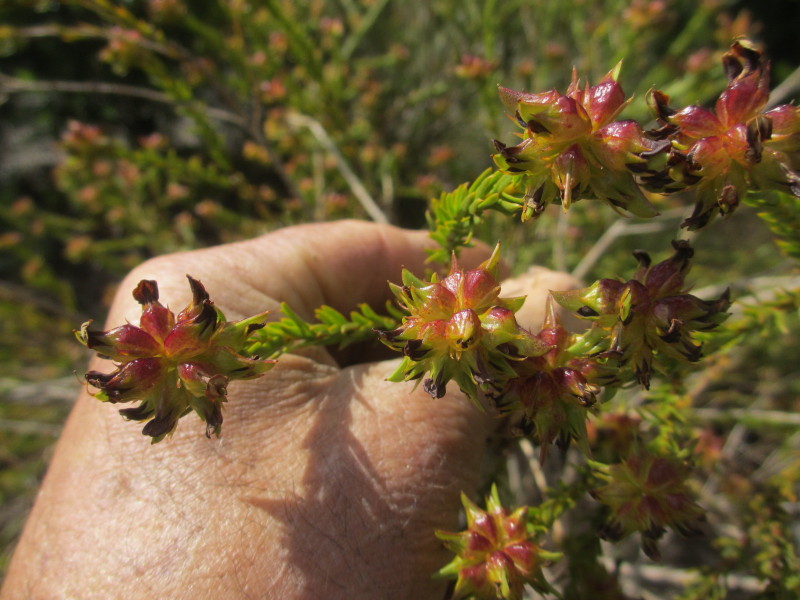 |
Aspalathus callosa? |
For the first time we've found flowers still on it, another yellow pea! Possibly Aspalathus callosa.
 |
Flower detail |
This gives an idea of the size of the plant, it must have been impressive with many of the flowers open!
 |
Whole plant |
We're sorry to have missed this little plant flowering.
 |
An Aristea? |
The spent flowers or seed pods looked familiar:
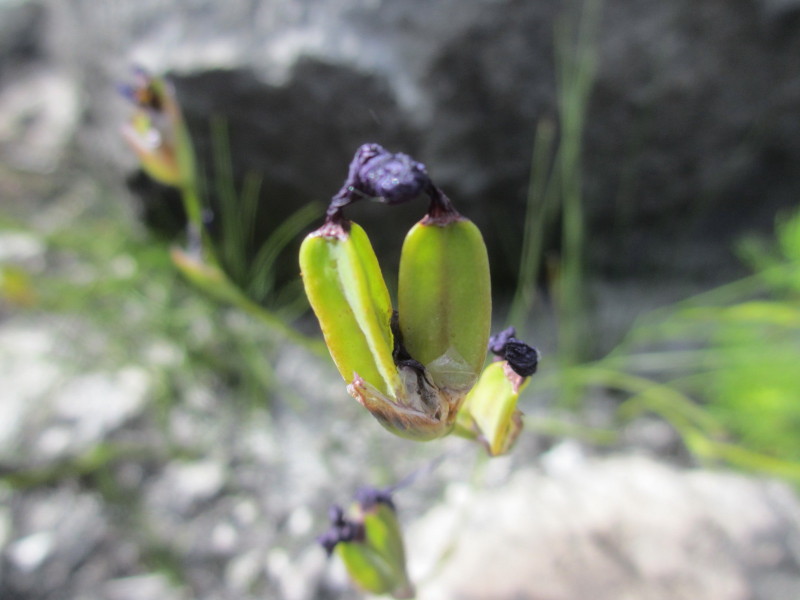 |
Spent flower up close |
Later in the walk we looked at the Aristea bakeri we have been watching (below), and found very similar pods. Could this (above) be Aristea racemosa, or A. juncifolia? It was past 4pm so it might have flowered this morning.
 |
Spent flowers of Aristea bakeri elsewhere |
Our first Therianthus this year! Growing here amongst Pseudoselago spuria which have nearly finished flowering. On the right are more about to open.
 |
First Therianthus! |
Here was an interesting plant, easily overlooked, but I spotted tiny flowers on the tips.
 |
Untidy red plant, lying down, with tiny pink flowers at the tips |
 |
Flower detail |
Here is another plant, not so far advanced:
 |
Les advanced plant, upright and greener |
We were aiming for the stand of Agapanthus walshii we have been watching open gradually for a few weeks.
 |
Agapanthus walshii |
The way the flowers hang sets them apart.
 |
Ten Agapanthus walshii flowers or buds on one plant! |
We counted 45 buds or flowers in this small area. Not bad for an extremely rare plant!
 |
Agapanthus walshii flowers |
A little way on, while watching a pair of black crows, Pippa noticed a splash of deep pink. Corymbium glabrum var glabrum, unless there's another variety with this deeper pink.
 |
Deep pink Corymbium |
We were making for the Curlygrass fern Schizaea pectinata we had found before, to find the fans of the flowers more fully developed and greener than before:
 |
Curlygrass Schizaea pectinata flowers up close |
I spotted what I thought was yet another Purple Powder Puff Pseudoselago serrata, but this was growing too close to the ground. Close up it was something completely different!
 |
This looks familiar, but we can't remember what it is! |
The flowers are deceptively long trumpets, and if you look carefully you can see long forked stamens coming out of some of the flowers. The closest we get is Merciera, but this grows too close to the ground for them.
 |
Flower detail, long trumpets and longer stamens! |
We found another Corymbium, further advanced and much paler than the previous one.
 |
Paler Corymbium |
Up there we found this Purple Powder Puff Pseudoselago serrata, definitely the biggest of the day!
 |
The biggest Powder Puff we found today! |
We wanted to check on the offspring of the burnt Pagoda flower Mimetes cucullatus which would have been in flower now. The babies are looking well!
 |
Baby Mimetes cucullatus |
These have clearly grown from seed scattered from the parent close by. Also in the Protea family, where we were disappointed that the re-growth we had seen at the bases of Protea cynaroides had shrivelled up, we are now finding seedlings close by:
 |
Baby Protea cynaroides |
What I thought last week was a Tar Pea Bolusafra bituminosa was identified by the experts as Rhynchosia because its leaves were in threes and pointed. This is more like it, with rounded leaves! We forgot to check if it was sticky!
 |
Tar Pea Bolusafra bituminosa |
It's late in the year to be finding Albuca. The latest in the books, up to November is A. cooperi, otherwise A. juncifolia would be a contender.
 |
Albuca, but which one? |
The leaves look like this:
 |
Albuca leaf |
We stopped off at the Watsonia borbonica from last week, looking as good as before!
 |
Watsonia borbonica |
And near it a sea of Combflowers, Micranthus:
 |
Combflowers Micranthus |
On the way back, this 'Weed' looked a bit out of place!
 |
The 'Weed' |
How did it get there?
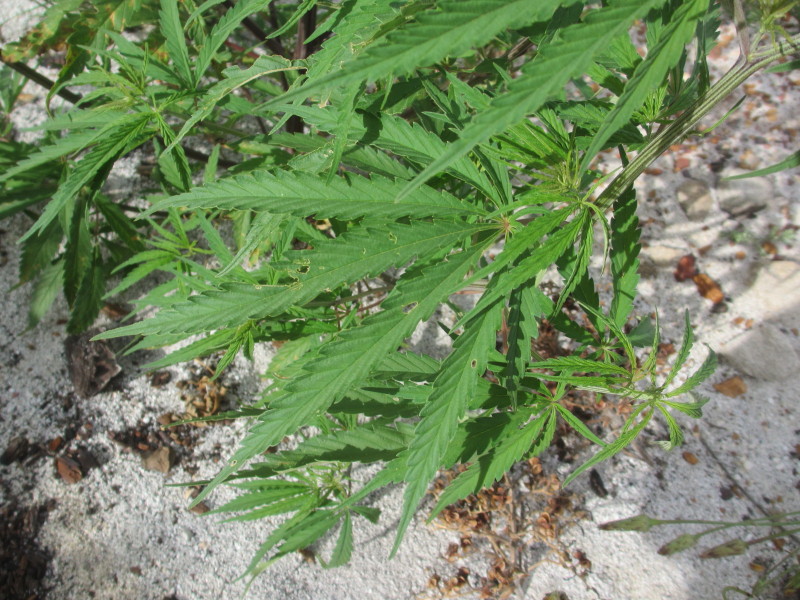 |
Leaf detail |
:-) A


