Showing posts with label new. Show all posts

Sunday, 18 May 2014

Mushroom-time Sunday Flower Walk

The first fungus we found was on a road in the experimental farm, a Common Earthball Sclerodermia citrinum. Don't eat it!
Sclerodermia citrinum
This Prickly Pear, Opuntia continues to flower, but only one or two are open at the moment:
Opuntia
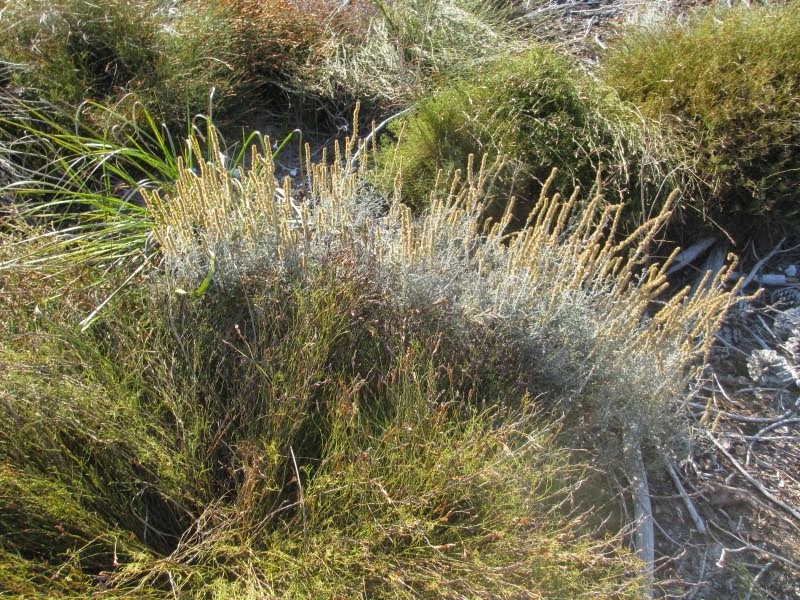
I asked for identification on this shrub a few weeks ago, growing between two Brunais. It has been crudely broken off on most of the stems, leaving only the base of the plant!
This is what it looked like a few weeks ago. Who would do this, why, and what is it?
At last, the light green / white Erica we have been watching for several weeks has started to show its full colours!
Erica spp
The whole plant will be covered in these little orange stamens (?) in a week or two! Could it be an E. plukenetii?
Erica plukenetii?
There are carpets of these Oxalis, particularly the pink ones, the bright yellow ones are seen just here and there.
Oxalis
A white Erica, still in full bloom. Some of the pink and mauve ones have turned a rusty red colour with spent flowers.
Erica spp
In the same area is another white one with a flower-within-a-flower, which looks like an E. lutea (apologies for the poor photos!)
Erica lutea?
Erica lutea?
This plant growing against a rock looked interesting, with tiny serrated leaves:

Up close, the flowers show a Lobelia arrangement of petals. We have seen this before and it looks like L. jasionoides:
Lobelia jasionoides
A cry from above, a Jackal Buzzard!
Jackal Buzzard
After a long wait, the Protea cynaroides are looking at their best now; they really are photogenic!
Protea cynaroides
And they live up to their common name, King Proteas!
Protea cynaroides
They are found here in the yellowy green above and pink:
Protea cynaroides
One of the first Liparia splendens or Mountain Dahlias we found is now looking considerably different from the rest! The flowers don't hang as much, they are smaller and more regular in shape:
Liparia splendens?
Liparia splendens?
Compare that with what we are more used to, a short distance away:
Liparia splendens
Is it the same species?
Another fungus, growing amongst the dead pine sticks, gilled with a longish stem:
Fungi
And another on the way home in an orchard:
Fungi
I wouldn't be in a hurry to eat either!
A bit of feedback on the shrub with red berries and Maple-shape (and colour!) leaves which we found in Max Harris Park last week:
Crataegus phaenopyrum
It had us guessing and the nearest was one of the Crataegus or Hawthorns, particularly C. Phaenopyrum, or Washington Hawthorn. I went back to look for the thorns and wasn't disappointed!
Crataegus phaenopyrum
Whether the Phaenopyrum, meaning 'looking like fire' refers to the leaves in Autumn or the berries themselves, we shall have to wait a week or two to find out!
:-) A


Sunday, 11 May 2014

A Walk in the Park and Sunday Flower Walk


This week's walk actually started last Sunday with an inspection of the Max Harris Park in the village, which a group of concerned Grabouwers tidied up after voting on Wednesday. The initiative came from Harold Smook of Elgin Food Exchange https://www.facebook.com/pages/Elgin-Food-Exchange/206725652834412. The Park already looks much more cared-for, after upwards of 40 people got stuck in, pruning, removing Port Jackson Acacia longifolia and cutting the grass.
Many interesting shrubs and other plants were found to be growing there, showing that whoever laid the park out many years ago, planted a good variety of both indigenous and exotic species. One shrub which has us guessing is this, any suggestions?
 
Now exposed from undergrowth are these Babiana, but which?
There are several examples of this Protea, could it be P. magnifica?
Now looking smart opposite the entrance is this Great Trek Monument. The picture gives an impression of how tidy the park now looks; it was completely overgrown! Hesma and Isabel are comparing historical notes!
Today was windy and sunny after a wet spell. This Metalasia is looking magnificent!
Detail of the flower:
Another, nearby was past its prime:
Last week in the forest we came across Star Grass, Ficinia radiata. This one grows taller and the flower is less showy. In the past we have assumed it was (yet another!) Restio, but now with eyes better tuned, this is similar, could it be Ficinia bergiana? Or F. indica?
Ficinia radiata
Detail of the flower:
Ficinia radiata flower
One by one the Protea cynaroides are opening!
Protea cynarioides
We were very pleased to see the number of Agapanthus walshii coming up where the South-easter has spread the seeds from a single plant we have watched flowering over the years. Here is a small one:
Agapanthus walshi
The A. walshii's have relatively few flowers on each stalk, not all of them produce viable seeds, and we have seen and photographed caterpillars in the fruits:
caterpillars in A. walshii seedpods
Here is the single flowering plant in this area:
A. walshii
Compare that with the spent flower of an A. africanus here in the garden:
A.africanus
We were hesitant to check on 'our' plants where tree felling is proceding. We found the ring of stones where we marked this year's Cyrtanthus ventricosa, under a felled tree. The others, almost in the cycle path are still there, just a few leaves:
Cyranthus ventricosa
'Our' Leucospermum oleifolium isn't looking happy at all!
Leucospermum oleifolium between fallen pines
And we had to uncover a large pile of pine cuttings lying on where we knew we'd find one of the Liparia splendens, with Agapanthus (not sure which kind) growing with it:
No doubt it will survive, and thrive in the full sun, and maybe the Aggie will flower! A piece of the Liparia had broken off:
Liparia splendens
We checked up on the whitish-green Erica to see how the flowers are developing:
Erica spp
Detail of the flower, still to open?
Erica spp
We're now more tuned in to the Fungi, since Pippa did a one-day course with Gary Goldman, and noticed these Common Puffballs, Vascellum pratense, on the way home:
Vascellum pratense
And these Field Mushrooms in the orchard of the Experimental Farm next door:
Until next time! :-) A


Sunday, 13 April 2014

Indian Summer Flower Walk

It shouldn't still be as hot as this? 32 degrees?
Well the Darter thought so!
Darter
Meanwhile, these two Puff Adders decided the weather was right for an amorous embrace!
Puff Adders embracing
On our way back, they were copulating; it's said they hatch up to 80 young!
Puff Adders copulating
We know where to find this Erica multumbellifera or Many Umbrellas Heath. What wasn't obvious were the holes in the sides of many of the flowers! Could it be, because the mouth of the flower is so small, that certain insects have to make a hole in the side to get to the pollen and nectar?
Erica multumbellifera
It's taking a long time, but gradually the Ericas are turning brown, flower by flower:
Erica spp
But just as we thought they were all over, we found one in bud! It looks as though the flowers will be white. We'll check!
Erica spp
This impressive Erica is growing in a circle, like a doughnut!
Erica circle
This tall Erica looks impressive now:
Erica spp
The Stoebe spiralis are covered with spent flowers, so the pale yellow splashes are now brown. But the new shoots are growing past the old flowers:
Stoebe spiralis
Likewise the Stoebe plumosa, or Seriphium plumosum, aka Slangbos:
Stoebe plumosa / Seriphium plumosum
I notice that the Liparia splendens ssp splendens, Mountain Dahlia or Orange Nodding Head is listed with SANBI as 'vulnerable'. We know of about eight plants in our small 'patch', Good News!
Liparia splendens ssp splendens
There are not so many flowers on this one, but it has recently been exposed to the sun by the regrowth pines being cut down. The flowers are distinctive:
Liparia splendens
This is a new one to us, the flower looks like an Oxalis, but the stem is long and the leaves are round. This one is growing up in another plant.
Oxalis spp
Pippa's sharp eyes spotted this which we think is Bulbinella trinervis:
Bulbinenella trinervis
The flower up close:
Bulbinenella trinervis
Close by were some spent flowers on another plant:
Bulbinenella trinervis
Chewing on a plucked leaf confirmed my guess: Tulbaghia, or wild garlic! We were in this area only a few weeks ago, the flowers must have come and gone quite quickly, otherwise we would have noticed them!
A Metalasia, with the same spiky leaves that I noticed at the other end of the valley a couple of weeks ago:
Metalasia spp
Metalasia spp
Impressive Restios:
Restio spp
Restio spp
We're noticing more and more Brabejum stellatifolium or Wild Almond. It's worrying that there's a vague similarity to Acacia longifolia, at least from a distance. We hope some over-zealous person with a back-pack sprayer doesn't confuse them!
Brabejum stellatifolium ?
We'll be watching the development of the flowers as they turn to fruit:
Brabejum stellatifolium ?
One last Tritoniopsis?
Tritoniopsis
Here's a shrub we need to find a name for, we're noticing more of them:
Closer-up, the older leaves turn a distinctive orange:
And this one, between two Bunias:
It's in flower now, the buds are slightly pink and the leaves serrated. Notice the ants on the stem!
It was still hot when we were on the way home!
On a farm in the week, I spotted this Honeysuckle:
Tecoma capensis
I'll be in the Eastern Freestate next weekend, I wonder what I'll find......... :-) A