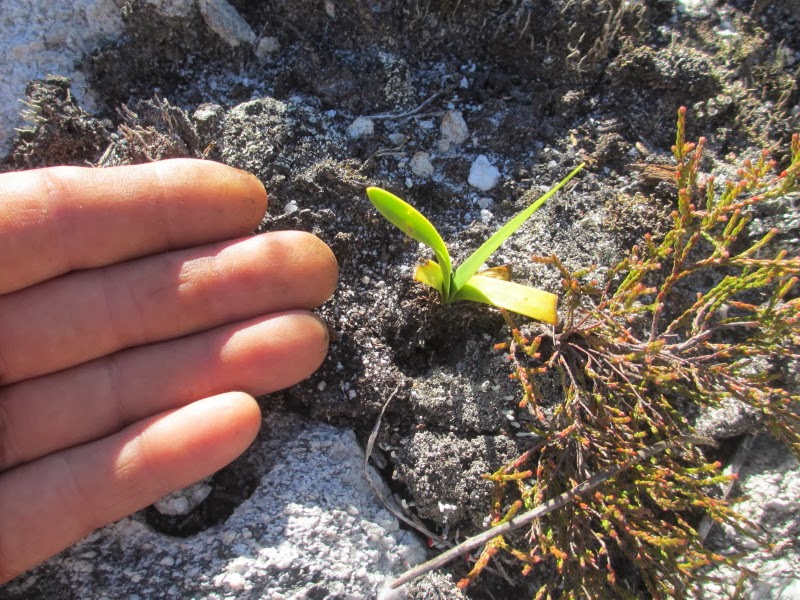
We've been watching for Dilatris pillansii up in the place we call 'the Gulley' for years. They seem to flower quickly and they're all over before we get back there next time. Today I happened on two plants in a completely different place, one in full bloom!
 |
Dilatris pillansii |
These weren't fully open, but one of them on the second plant was!
 |
Dilatris pillansii flower |
Closer.....
 |
Flower detail of Dilatris pillansii |
Without the flowers, we forget which plants are D. pillansii, so we noted the leaf carefully. Flat, pointed and about four lines, not ribs, just visible:
I had been wandering well off the track while Pippa sketched the red-tipped leaves of a Leucadendron:
 |
Leaf detail of Dilatris pillansii |
I had been wandering well off the track while Pippa sketched the red-tipped leaves of a Leucadendron:
 |
Leucadendron with red-tipped leaves |
Very close to the Dilatris, Pippa spotted a Stargrass Ficinia radiata, which we last saw in the forest and haven't noticed in the open before:
 |
Stargrass Ficinia radiata |
Again in this immediate vicinity, we found tufts of grass (?) with flowers (again!), and we're still not sure whether the flowers belong to the grass, or just use them as a host. There were no similar flowers in any other plants close by:
 |
Unknown grass (?) with flowers |
Most of these flowers were partly closed, but we found one flower fully open:
 |
Detail of open flower |
Four pointed petals behind, four more rounded ones in front......? So that was three 'finds' within a few square metres!
But I'm ahead of myself, on the way past the Railway cottage ruins, the unpleasant smell of the Helichrysum foetidum is quite strong!
 |
Helichrysum foetidum |
It really smells as if something's dead :-( But the flowers are pretty!
 |
Helichrysum foetidum flowers |
There are still many flowers out on the Sundews Drosera trinervia (?) and more buds to come behind!
 |
Sundew Drosera trinervia (?) |
Watch out, insects!
 |
'Forest' of Sundews Drosera trinervia (?) |
Just beginning to open, Sentry in a Box Albuca canadensis:
 |
Albuca canadensis |
Flower detail:
 |
Albuca canadensis flower |
The seed pods of the Wachendorfia paniculata lower down, which flowered early, are changing colour to their characteristic orange 'turbans':
 |
Wachendorfia paniculata seed pods turning orange |
Yesterday, on the way home from the Villiersdorp Agri & Arts Festival, I just had to pull the old truck off the road and take a photo of a whole hillside covered in Wachendorfias! As can be seen, there has been a fire here recently.
 |
Wachendorfia paniculata covering a hillside on Viljoens Pass |
This Orchid was worth stopping for:
 |
Orchid spp. |
And a magnificent Wachendorfia with a lot of flowering still to do!
 |
Magnificent Wachendorfia paniculata |
Here are the white flowers which have got us guessing. The close bunches of flowers from last week have opened up as their stalks have lengthened, so the florets are further apart.
 |
Unknown plant, possibly Pseudoselago ascendens (?) |
Flower detail:
 |
Flower detail |
Leaf detail:
 |
Leaf detail |
And another plant which seems further advanced, showing the stalks and leaves drying up. Dominic has suggested it may be Pseudoselago ascendens 'as a good guess' - also called Selago incisa.
 |
Plant in advanced stage |
We'll be watching them as they dry further, to see if they then look like this picture from Missouri Botanical Herbarium, which gives both names:
 |
Specimen with both possible names in Missouri |
The Pelargoniums are looking really good in full bloom:
 |
Pelargonium flower |
 |
Pelargoniums on hillside |
On the way home we stopped for these Sparaxis bulbifera, which are finished on the other side of the railway line. The backs of the petals are distinctive.
 |
Sparaxis bulbifera |
More on Yesterday's Show in Villiersdorp: There really was a lot going on, especially with the Arts combined with a Commercial Show. In one of the halls was a display of wild flowers which are in bloom at the moment, all identified by local Maureen Cumming. I was delighted to find an example of the little pink ball-type flower we have found recently and suspected as being a Helichrysum:
 |
Specimen at Villiersdorp identified as Anaxeton asperum |
The leaves are the same as 'ours':
 |
Leaf detail of specimen |
The identification was Anaxeton asperum, which is indeed a Helichrysum. There must have been more than 100 flowers on display, this was only a part!
 |
Part of the wild flower display at Villiersdorp Agri & Arts Festival |
:-) A