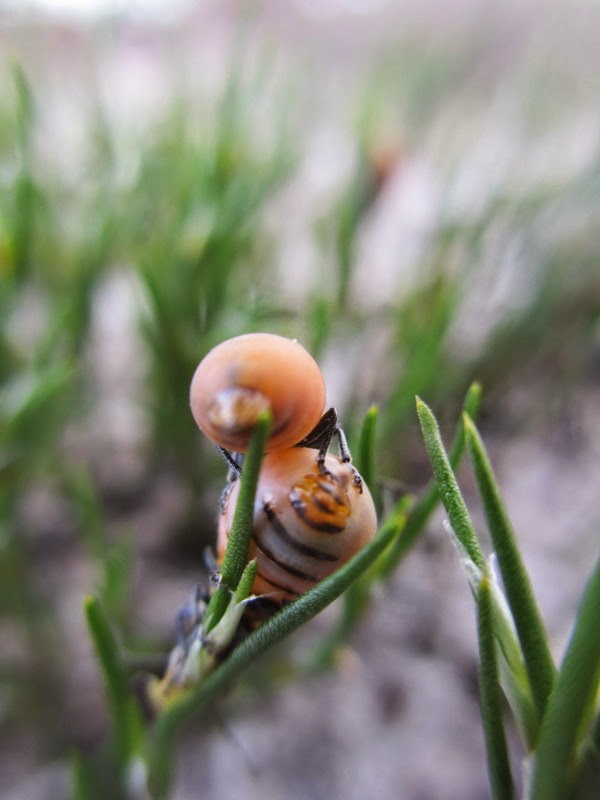
Showing posts with label pseudorupilia. Show all posts

Sunday, 24 May 2015

Gloomy Sunday Flower Walk

Yes, gloomy and overcast and a South-westerly wind from Gordon's Bay. We've had a few light showers since the fire, but no real rain so far.
Lack of sunshine meant that our 'new find for the day' was closed, Oxalis Polyphylla which we've never noticed before!

Oxalis polyphylla

The more normal pink Oxalis has a clover-like leaf, we saw some later:

Our more familiar pink Oxalis

In the middle upper part of the picture above is a plant we have started to find, not sure what it will turn into, but we're watching!
On the way out we found some puff-balls Scleroderma citrinum (?) which are easily mistaken for stones in the road:

Puffballs in the track

Another Puffball

We're still finding plenty of Swollen Restio Beetles Pseudorupilia on the new growth of Restios, but not on any of the tufts of grass.
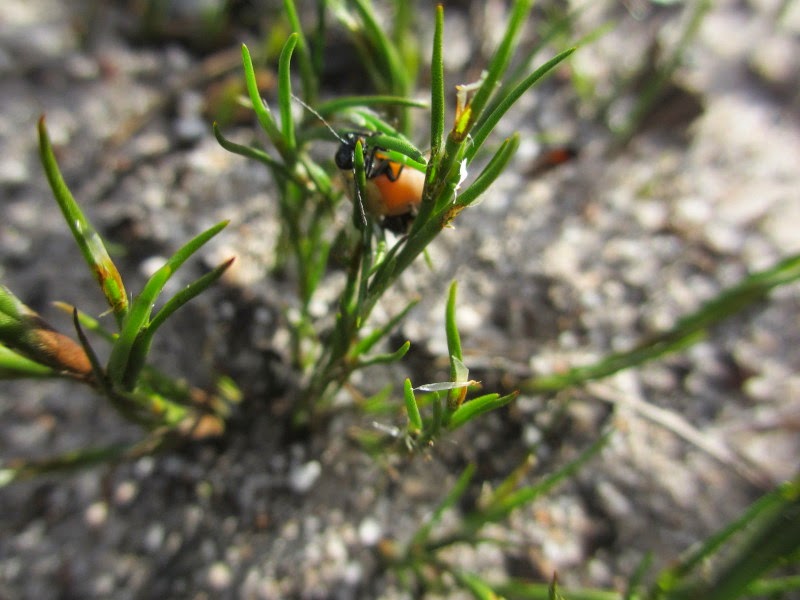
Swollen Restio Beetle Pseudorupilia

The densest stand we've found so far of Agapanthus walshii is coming along nicely!

Agapanthus walshii, doing well!

The Leucospermum oleifolium nearby is doing nothing yet.

Leucospermum oleifolium, no sign of life since the fire

What I'd hoped would be re-shooting at the base of the Heeria, is in fact Pelargonium!

Pelargoniums growing at the base of the burned Heeria

In places the Pelargoniums are coming up well!

Pelargoniums

Where the fire was hottest, the Palmiet has burned off completely and there's no sign of shooting. In other places, it's very encouraging.

Palmiet, recovering

We're still confused with the bushes we're seeing shooting from their bases. These leaves are in threes and are veined diagonally from the centre.

We had thought this might be Cape Myrtle but it's all wrong!

The burned remains of berries can be found.

Detail of a burned branch, with berries

New leaf detail:

Leaf detail, showing radiating veins

In many cases, these were saved from the worst of the fire's heat by their growing next to or between rocks. Here's another:

Another similar plant

How lucky we are to live here!

Eikenhof Dam and Groenlandberg

We found just two Tritoniopsis lata today, but what's that behind?  

Tritoniopsis lata

We were able to have a good look at the leaves here, definitely multi-ribbed:

Leaf detail

What might this be, next to an Oxalis?

What are these leaves?

We found several Fire Asparagus Asparagus Lignosus, this one's berries have turned dark:

Asparagus lignosus with dark berries

Others are still green.

Asparagus lignosus with still-green berries

And some are still in flower:

Asparagus lignosus in flower still

This gives an idea of how densely they sometimes grow!

Dense stand of Asparagus lignosus

'Till next time, from the Wurm.....

Wurm on the alert

.... and the Boy, who was determined to get in the pictures, every time!

I want to be in this picture!

:-) A


Sunday, 17 May 2015

Gradual regrowth, with fungus, Sunday Flower Walk

I was at Mostert's Mill in Cape Town on Saturday and spotted this amongst the roses:

Magpie Fungus Coprinopsis picacea from the top

I sent it in to iSpot and the consensus is that it is a Magpie Fungus Coprinopsis picacea.

... and from the side

Here's another type of fungus we found on the farm. Colin Ralston on iSpot (kindly!) suggests it might be a Russula

Russula (?)


Russula (?) up close


This picture shows the gills

In the unburned area, this Slangbos which I think is Stoebe plumosa / Seriphium plumosum was in flower with tufts of white fluff:

Slangbos Seriphium plumosum (?)

It looks as though the bunches of brown cones are buds which take turns to all open at the same time.

Flower detail

These Swollen Restio Beetles Pseudorupilia were at it again:  

Swollen Restio beetles Pseudorupilia

We're wondering about these Wachendorfias, with leaves growing radially, so curved and so close to the ground. Is it as a result of the fire, perhaps?  

Wachendorfias growing unusually, or are they different from W. paniculata?

Dominic has suggested that this is re-growing Cape Myrtle Myrsine africana. He says the red stems help with diagnosis. These leaves look more spear-shaped than those on the web, so I'm not too sure.

Is this Cape Myrtle Myrsine africana?

This, again, looks different. We are going to have fun identifying them all!

If so, what is this? 

It's disappointing to see these aliens growing in such profusion in the wetter spots. It's astonishing that the seeds are so prolific even so long after the introduction of biological controls! We pulled up hundreds, then gave up!

Hundreds of aliens growing in the damp spots :-( 

This had us confused, we even wondered if it was Eucalyptyus, but there was no smell from a crushed leaf.

Not sure what this is!

It was growing in a carpet of yellow Oxalis, closed because it was gloomy.

Yellow Oxalis in the still-standing but burned forest

The pods of these burned King Proteas Protea cynaroides are picture-perfect!

These seed pods of the King Protea Protea cynaroides have dispersed all their seeds

How's this for a row of Agapanthus walshii? It's as if they really needed a fire! There were perhaps 4 plants here before.

Agapanthus walshii

Still some way from home on the way back, we saw four white birds flying in to the dam on the experimental farm which is very empty at the moment. We thought they were Sacred ibis, but something didn't look quite right. Sure enough, three were Spoonbills!

A Sacred Ibis and three Spoonbills

Last week, on the bank we saw this fresh spoor; the lack of claw-marks makes it a dead ringer for the African Clawless Otter Aonyx capensis:

Spoor of African Clawless Otter

:-) A


Sunday, 3 May 2015

Ceiba speciosa Sunday Flower Walk

Actually it was on Friday, our May Day holiday, that I saw the Ceibas (formerly Chorisia) and had driven past them before I realised what I'd been past! There is a row of these spiny-barked Silk Floss Ceiba speciosa trees next to the gate of the farm Le Chasseur on a back road near Robertson.

Flowers of Silk Floss Tree Ceiba speciosa with single or combined stamen

The flowers are difficult to miss! It seems the row is a collection, because there is a pale one too.

Pale version, also with single stamen

The single stamens on all of these flowers differ from those on the tree here in the Village outside Grabouw Auto Electrical, which have five individual stamens.

Multiple stamens here in Grabouw

The story behind these trees in South Africa began with a pillow brought from South America stuffed with the floss from the seed pods of this plant. A lump was found which turned out to be a seed. It was planted and it flourished!
The Bolivian Legend of the Toborochi Tree (Chorisia speciosa) goes like this: When the world was still very new, the Aña, or spirits of the darkness, liked to abuse and murder humans. Then they found out that Araverá, the beautiful daughter of cacique Ururuti, who had married the Hummingbird god Colibri, was pregnant and would give birth to a son who would punish them, so they decided to kill her. With the help of a flying seat her husband had given to her, Araverá fled from the village, but the evil spirits followed her and harassed her wherever they found her hiding. Tired, she decided to hide in the trunk of a Toborochi tree where she gave birth to her son in peace.The boy grew up and fulfilled the prophecy, avenging his mother, who had to stay inside the tree until she died. Forever buried in the amphora-shaped trunk of a Toborochi, Araverá likes to come outside in the shape of a beautiful flower that attracts hummingbirds, that way, she keeps contact with her husband.

The tree in Grabouw

There seems to be no agreement over the single and multiple stamens and the general comment is that they have hybridised over the years and may well have before being imported.
At least that gives some colour to the 'walk' which was decidedly lacking in it, except for green which gets more every week. We had a little rain this last week which must have helped.
We checked the Gladiolus carneus we tracked down two weeks ago and were disappointed to see some animal had dug up some of the bulbs. We put them back and covered them and we'll hope for the best.

We think these are Gladiolus carneus, dug up by an animal

The yellow Oxalis give a bit of colour here and there.....

Yellow Oxalis

..... as do the pink ones, although it was overcast and they were closing.

Pink Oxalis

Anina told us to look out for the branched and frilly sterile culms which will come up first out of the burned remains of the Restios. These are beginning to appear, but with them (and them only), we spotted insects.

The iSpot experts agree these are Swollen Restio Beetles Pseudorupilia, but which one? 

More on the way?

I have put a request for identification on iSpot.

More Restio beetles

This Wachendorfia is looking spectacular, the one behind it seems to have been eaten off. There are many rabbit tracks.

Wachendorfia, probably W. paniculata

Not sure what this is, but it's growing nicely out of a burned stump!

Unknown bush re-growing

This one I do recognise as a Brachylaena neriifolia.

Brachylaena neriifolia re-growing

We reported on this stand of Agapanthus, presumably the rare A. walshii in an area where we had not found them before. My count went past 50 individual plants!

More than 50 Agapanthus probably A. walshii in one place

When we did see colour, it stood out! This Tritoniopsis lata would have been difficult to miss!

Tritoniopsis lata

The Pelargoniums are coming back strongly, we know where they were best before.

Pelargonium

Outside the railway cottage ruins is a stump with impressive Cinnabar Brackets Pycnoporus sanguineus.

Cinnabar Brackets Pycnoporus sanguineus

Also there, it's difficult to go past the Prickly Pear Opuntia and not look at the flowers!

Prickly Pear Opuntia flower

Back on the farm this Daisy begged to be photographed:

Unknown Daisy flower

From the side:

Same Daisy from the side

.... and the leaves. Which one is it?

Whole plant including leaves, what is it?

Also at home was this Bolete (?):

Is this a Bolete? 

From underneath, still to be identified.

From underneath

:-) A