Showing posts with label lata. Show all posts

Sunday, 14 June 2015

Blustery Northwester Sunday Flower Walk

There was a blustery Northwester today, making life quite unpleasant on the hills!
We've got so used to Oxalis being the only source of colour, imagine how excited we were to find this!

A Daisy, but which one?

A Daisy, but which? The leaves have been chewed off in places but those on the sand show the full shape.

The whole plant, showing the leaves

We retraced our steps from last week and found the plant we had marked with a ring of stones. What looked like a stalk  last week is in fact a third leaf. The others have grown longer in the meantime. Dominic has warned us that we will need an Orchid guide book this late winter!

What we found last week, the central 'stalk' is a third leaf

Once our eyes were tuned to this plant, we found more in that area.
We are still baffled by this plant which Pat says is not a Wachendorfia, despite its pleated leaves.

Pleated leaves, beautiful shapes, and not a Wachendorfia?

What is very noticeable is how hairy the leaves are.

The leaves are very hairy

We're watching this plant develop...... but what is it?

What is this?

The Fire Asparagus Asparagus lignosus have set many berries, green turning to deep red.

Berries on Fire Asparagus Asparagus lignosus

We're not sure what this will turn into.

What is this?

If all these Agapanthus walshii flower, right next to the road, it will be an impressive sight!

Many Agapanthus walshii!

Another unknown, growing at the base of a large rock.

What is this?

Is this a Rhus / Searsia? Pat said we should fold a leaf and then let go.

Folding a leaf on a suspected Searsia

..... If it leaves a white line, then it's diagnostic to one particular Searsia. This one did not!

No white line left after folding

Here are the sterile culms growing at the base of a burned Restio, which Anina told us to expect. The Swollen Restio Beetles Pseudorupilia seem to have disappeared.

Sterile culms growing at the base of a burned Restio

Just one Tritoniopsis lata made a welcome break to the grey and green.

Tritoniopsis lata flower

The Boy checking a new cycle track sign for smells!

New sign for cycle/hiking trail

The first bud on a Lanaria lanata! There will be hundreds soon!

First Lanaria lanata bud observed

That's it from us for this week!

Or like stout Cortez when with eagle eyes (s)he star'd at the Pacific...


:-) A


Sunday, 24 May 2015

Gloomy Sunday Flower Walk

Yes, gloomy and overcast and a South-westerly wind from Gordon's Bay. We've had a few light showers since the fire, but no real rain so far.
Lack of sunshine meant that our 'new find for the day' was closed, Oxalis Polyphylla which we've never noticed before!

Oxalis polyphylla

The more normal pink Oxalis has a clover-like leaf, we saw some later:

Our more familiar pink Oxalis

In the middle upper part of the picture above is a plant we have started to find, not sure what it will turn into, but we're watching!
On the way out we found some puff-balls Scleroderma citrinum (?) which are easily mistaken for stones in the road:

Puffballs in the track

Another Puffball

We're still finding plenty of Swollen Restio Beetles Pseudorupilia on the new growth of Restios, but not on any of the tufts of grass.

Swollen Restio Beetle Pseudorupilia

The densest stand we've found so far of Agapanthus walshii is coming along nicely!

Agapanthus walshii, doing well!

The Leucospermum oleifolium nearby is doing nothing yet.

Leucospermum oleifolium, no sign of life since the fire

What I'd hoped would be re-shooting at the base of the Heeria, is in fact Pelargonium!

Pelargoniums growing at the base of the burned Heeria

In places the Pelargoniums are coming up well!

Pelargoniums

Where the fire was hottest, the Palmiet has burned off completely and there's no sign of shooting. In other places, it's very encouraging.

Palmiet, recovering

We're still confused with the bushes we're seeing shooting from their bases. These leaves are in threes and are veined diagonally from the centre.

We had thought this might be Cape Myrtle but it's all wrong!

The burned remains of berries can be found.

Detail of a burned branch, with berries

New leaf detail:

Leaf detail, showing radiating veins

In many cases, these were saved from the worst of the fire's heat by their growing next to or between rocks. Here's another:

Another similar plant

How lucky we are to live here!

Eikenhof Dam and Groenlandberg

We found just two Tritoniopsis lata today, but what's that behind?  

Tritoniopsis lata

We were able to have a good look at the leaves here, definitely multi-ribbed:

Leaf detail

What might this be, next to an Oxalis?

What are these leaves?

We found several Fire Asparagus Asparagus Lignosus, this one's berries have turned dark:

Asparagus lignosus with dark berries

Others are still green.

Asparagus lignosus with still-green berries

And some are still in flower:

Asparagus lignosus in flower still

This gives an idea of how densely they sometimes grow!

Dense stand of Asparagus lignosus

'Till next time, from the Wurm.....

Wurm on the alert

.... and the Boy, who was determined to get in the pictures, every time!

I want to be in this picture!

:-) A


Sunday, 17 May 2015

Tritoniopsis lata Sunday Flower Walk

Well, that was the most spectacular flower, and we found only one!

Tritoniopsis lata flower

The whole plant isn't very robust, with a single narrow leaf:

Tritoniopsis lata plant

This left us wondering what we are expecting from these two plants, with very different leaves. With the sun behind, this one has about four distinct parallel ribs, and it's growing from a bulb:

Bulb with four ribs in the leaves

.... and this one which has just one rib in the middle, and it's growing in a fan like an iris:

Iris-type with one rib

In that area, there are Wachendorfias with curved leaves growing close to the ground. They almost reminded us of Welwitschias!

Wachendorfia, growing close to the ground, why? 

Are they Wachendorfia paniculata, or something else which we haven't found before, brought on by the fire?

Another Wachendorfia

As usual, we had to look for colours other than the steady increase of green. Yellow Oxalis:

Yellow Oxalis

Carpets of them in places!

Yellow Oxalis carpet!

Pink also!

 And pink Oxalis!

It was good to see Anka training as usual, both she and the horse must be very fit! She is just passing the stand of Agapanthus walshii which are coming up nicely!

Anka training, riding past Agapanthus walshii

We've never found them in this place before.

These are those Agapanthus walshii

Pippa the archaeologist had a find! Unfortunately not Stone-Age!

Archaeologist finds iron-age axe ;-)

Here's a Daisy which we think is Euryops.

Daisy, is it an Euryops?

I have been taught to photograph the underside of the flower, so here it is. Any ideas? :

Detail of the underside of the Daisy

Here's something coming up strongly after the fire; can't quite place it yet.......

What is this, growing up after the fire?

And who's this, what will it turn into? What can it possibly find to eat? Or is it a wood-borer?

Caterpillar on bark and stump, no greens around!

The Fire Asparagus Asparagus lignosus have berries on them now and the lime green of their leaves has turned duller. The thorns are just as sharp!

Fire Asparagus Asparagus lignosus berries and now dull green leaves

We wondered what this might be, with a fleshy, smooth, almost succulent leaf. Trying to remember what was growing here before the fire, Pippa suggested Othonna quinquedentata, five toothed Baboon Cabbage. Could the 'five teeth' be from the shape of the leaves?

Can this be Othonna quinquedentata

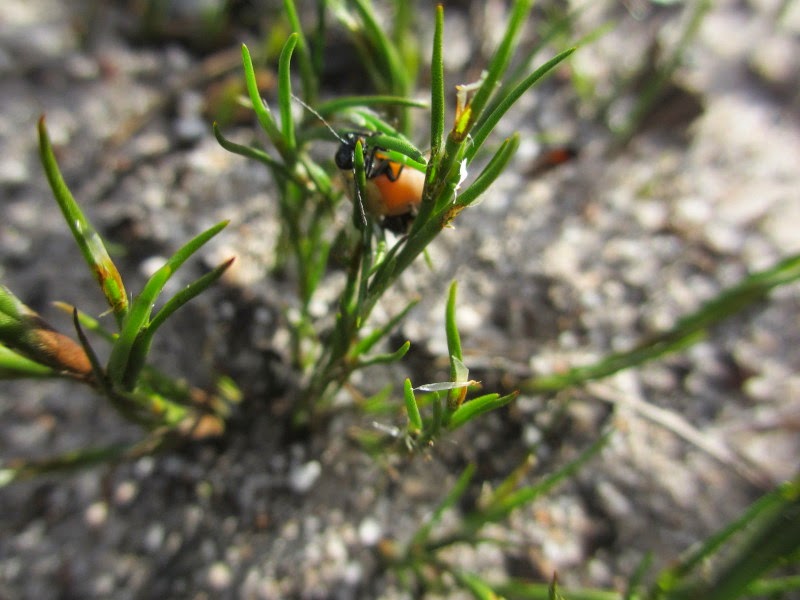
I'm not sure if the Ladybird has been eating the leaves of this grass (?) like that?

Ladybird on grass, has it eaten the tips off? 

From the heights, we were puzzled by the look of a train coming past. Part passenger? Phelophela Health Care Train? No, a massive weedkill rig, Contra-Chem.

Contra-Chem weedkill train

We don't expect to see many birds in the burned area, but this one was hopping around quickly, close to the ground, from stump to stump at the very limit of my camera's range, pecking the ground here and there. Looked fat enough! About the size of an Olive Thrush, any ideas?

Could this be a Pipit?

This, outside the farm this morning, was easier to identify! Well, by its old name Gymnogene, anyway. Now African Harrier Hawk Polyboroides typus.

Gymnogene, African Harrier Hawk Polyboroides typus

Yesterday at the Compagnes Drift Watermill the Forest Elder (Bosvlier) Nuxia floribunda is looking spectacular! One visitor asked both Noel and me, separately, if we knew what it was. We both surprised him!

Nuxia floribunda at Compagnes Drift Watermill

Also there, the Pig's Ears Cotyledon obiculata (?) are in flower.

Cotyledon obiculata (?)

Along with this succulent, can anybody name it?

Unknown succulent

And here in the garden, a Granadilla Passiflora ligularis in last week's shower! My wife tells me I'm a big dummy, it's a Clematis! The plants are in a complete tangle there, with this Clematis, the Granadilla, a Hanepoot grape, a climbing rose, a Pandorea jasminoides, and behind, a huge Camellia and a Yesterday-today-and-tomorrow!

Clematis in the garden, after rain

 :-) A