Showing posts with label Palmiet. Show all posts

Sunday, 24 May 2015

Gloomy Sunday Flower Walk

Yes, gloomy and overcast and a South-westerly wind from Gordon's Bay. We've had a few light showers since the fire, but no real rain so far.
Lack of sunshine meant that our 'new find for the day' was closed, Oxalis Polyphylla which we've never noticed before!

Oxalis polyphylla

The more normal pink Oxalis has a clover-like leaf, we saw some later:

Our more familiar pink Oxalis

In the middle upper part of the picture above is a plant we have started to find, not sure what it will turn into, but we're watching!
On the way out we found some puff-balls Scleroderma citrinum (?) which are easily mistaken for stones in the road:

Puffballs in the track

Another Puffball

We're still finding plenty of Swollen Restio Beetles Pseudorupilia on the new growth of Restios, but not on any of the tufts of grass.
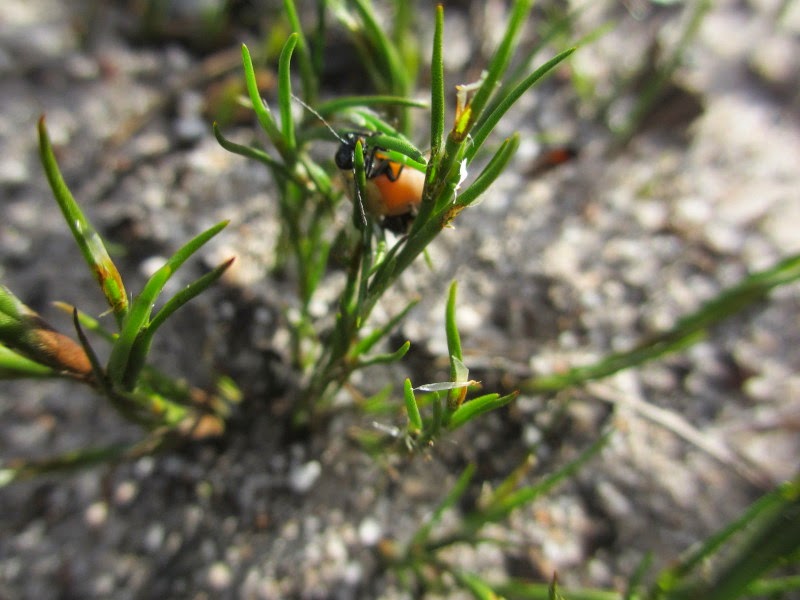
Swollen Restio Beetle Pseudorupilia

The densest stand we've found so far of Agapanthus walshii is coming along nicely!

Agapanthus walshii, doing well!

The Leucospermum oleifolium nearby is doing nothing yet.

Leucospermum oleifolium, no sign of life since the fire

What I'd hoped would be re-shooting at the base of the Heeria, is in fact Pelargonium!

Pelargoniums growing at the base of the burned Heeria

In places the Pelargoniums are coming up well!

Pelargoniums

Where the fire was hottest, the Palmiet has burned off completely and there's no sign of shooting. In other places, it's very encouraging.

Palmiet, recovering

We're still confused with the bushes we're seeing shooting from their bases. These leaves are in threes and are veined diagonally from the centre.

We had thought this might be Cape Myrtle but it's all wrong!

The burned remains of berries can be found.

Detail of a burned branch, with berries

New leaf detail:

Leaf detail, showing radiating veins

In many cases, these were saved from the worst of the fire's heat by their growing next to or between rocks. Here's another:

Another similar plant

How lucky we are to live here!

Eikenhof Dam and Groenlandberg

We found just two Tritoniopsis lata today, but what's that behind?  

Tritoniopsis lata

We were able to have a good look at the leaves here, definitely multi-ribbed:

Leaf detail

What might this be, next to an Oxalis?

What are these leaves?

We found several Fire Asparagus Asparagus Lignosus, this one's berries have turned dark:

Asparagus lignosus with dark berries

Others are still green.

Asparagus lignosus with still-green berries

And some are still in flower:

Asparagus lignosus in flower still

This gives an idea of how densely they sometimes grow!

Dense stand of Asparagus lignosus

'Till next time, from the Wurm.....

Wurm on the alert

.... and the Boy, who was determined to get in the pictures, every time!

I want to be in this picture!

:-) A


Sunday, 19 April 2015

Agapanthus walshii Recovery Sunday Flower Walk

Certainly, the re-emergence of Agapanthus walshii plants was the highlight of our walk. No chance of flowers for a long time yet, but it was good to see those we know of coming back strongly. In one place where we knew they were and can't find them, we're still hoping they'll come up again. Yet in another where we didn't know they were, close to a road we use often, we found a stand over several square metres and it was easy to count to 33 individual plants!

No less than 33 Agapanthus walshii plants in this small area!

In another place where we knew of one or two, there was a whole row. Considering their rarity, this is all good news and interesting to see that they seem to have benefited from the fire which was now about eight weeks ago. Their status in 2004 was described thus: 'Known from a restricted range (35 km²) in the Elgin valley, recorded from less than five locations with continuing decline of the largest subpopulation occurring as a result of informal settlement expansion.'

A whole row of Agapanthus walshii where there was one or two

Elsewhere, sprouting at the base of shrubs was pleasing, like this fairly large Brachylaena neriifolia:

Sprouting from the base of a Brachylaena neriifolia

This Fire Asparagus Asparagus lignosus seems to be past its best now, with lower branches dying back. The ground underneath is strewn with spent flowers or seeds.

Fire Asparagus Asparagus lignosus, past its best

Another one is less far advanced, with flowers still out:

A younger Asparagus lignosus

The flowers are tiny and delicate:

Asparagus lignosus flowers, leaves and thorns!

This Palmiet is recovering nicely:

Palmiet, recovering

We're waiting to see what will happen to this Pagoda Flower Mimetes cucullatus; nothing yet!

Mimetes cucullatus, nothing happening yet

This is what the burned flower looks like:

Mimetes cucullatus, burned flower

Again, there was very little colour, a splash of yellow here and there from this Oxalis (luteola?):

Yellow Oxalis (luteola?)

.... and pink from these:

Pink Oxalis (hirta?)

Also pink, this Tritoniopsis (lata?) which was the only one we spied!

Our only Tritoniopsis (lata?) sighting today

It was interesting to see a bare flower stem growing from one hole and a single leaf from another!

This is how it was growing

Flower detail:

With the long upper tepal, is this Tritoniopsis lata

Growing in the middle of the road, we're amazed always that this Campylostachys cernua survives. Burned, but spared the worst of the fire, it's shooting from the base:

Campylostachys cernua, in the middle of the road, burned, but recovering!

But it was very pleasing to find what we think is another one, growing about 10 metres away, safely away from the road:

Another one, a short distance away?

Using our markers, mostly stones packed on the side of the road, we are able to trace where we remember plants were growing before the fire. In this case, Dilatris pillansii, recovering well.

Recovering Dilatris pillansii

Working from another stone marker, and in relation to a Lanaria lanata which has recovered well, we were delighted to find this which we're pretty sure is the big stand of Gladiolus carneus we found. It was right at the edge of the fire and seems to be coming up again strongly:

Gladiolus carneus coming up again? 

We have marked it with sticks along with the Lanaria lanata:

Marked with sticks


:-) A


Thursday, 16 April 2015

Mostly Green Sunday Flower Walk

Although the burned veld looks grey from a distance, now after seven weeks, the colour is returning, although it's mostly green leaves. Here and there a splash of colour is visible from a distance, like this Tritoniopsis, in a crack in the rock which escaped the worst of the fire, Possibly T. antholyza. It looks as if we're in for a good showing of them in the next few weeks, judging from the leaves coming up.

Tritoniopsis in a crack in the rocks

Jennetta wrote in for more details of the Buchu Agathosma we have been watching. We have assumed it's A. betulina, but she's wondering whether it could be A. crelulata ?

Agathosma, but betulina or crenulata?

Some of the guide books don't show the leaves, which apparently distinguish them. Here is a close-up of them. Comments, please! However, there's no mistaking the Buchu aroma! We are also watching its babies growing all around it, getting bigger by the year!

Leaf detail of the Agathosma

The re-growth of the Lanaria lanata has reached about 400mm in most places, and the leaves are beginning to hang down. Here the tips are describing arcs in the bare sand.

Lanaria lanata leaves making arcs in the sand

One would expect a shrub like this to be very dead after suffering a 'hot' fire like this, but Fynbos is resilient! Not sure yet what this is:

Re-growth from the base of a burned shrub

We went to see the large Leucospermum oleifolium we found just before the fire.

Burned Leucospermum oleifolium plant

Close inspection of the spent flowers shows there might be life in the seeds yet!

Detail of the seeds in the burned spent flower. Is there life?

Here, a Liparia splendens which was burned, is shooting from its base:

Liparia splendens with re-growth at base

..... and another, we remember that's what was growing here, formerly within the forest, now it'll be in full sun. This one was totally burned-off:

Liparia splendens re-growth where it was completely burned off

Amazingly, there are still a few seeds to distribute from this Protea cynaroides!

Still a few seeds on the Protea cynaroides

Palmiet, recovering:

Palmiet

Pink Oxalis are to be seen here and there, and more to come, judging from the clover-lile leaves to be seen all over.

Oxalis

The Fire Asparagus, Asparagus lignosus isn't growing as fast as it did in the first few weeks, but it makes a pretty plant with its little white flowers (and sharp thorns!).
Recovering Agapanthus walshii:

We counted 24 flowers on these Agapanthus walshii before the fire

Had we not packed rocks around this plant, the two bicycles might well have ridden right over them! Can't they stick to the tracks?

Two bicycles narrowly missed this rare Agapanthus walshii plant

Back in the Village, outside Grabouw Auto Electrical, the Silk Floss Tree Ceiba speciosa (formerly Chorisia speciosa). For some reason only a high branch is flowering this year.

Silk Floss Tree Ceiba speciosa in flower in the Village

Apparently the seeds were imported in the stuffing of a pillow from South America many years ago and planted in Rondebosch, and grew! Related to the Baobab and Kapok Tree, I read. You only lean on this trunk once!

Sharp spines on the Silk Floss Tree trunk!

Last weekend I visited the Eastern Freestate, where one comes across different plants. Here on the farm, a field of Cosmos, which is much darker than the roadside specimens, is the result of selective breeding:

Deep pink Cosmos as far as you can see!

More Cosmos!

Every day we went out on a Military Vehicle convoy near the Lesotho border....

Very different terrain in the Eastern Freestate!

and on the stops, we were able to observe what was growing next to the track:

Unknown flower on the side of the track

Any guesses?

This is what the plant looks like

Another, there were several more unfamiliar plants:

Glossy leaves and a tall flower head

Shiny leaves above and spent flowers below:

Spent flowers on the head

:-) A