Showing posts with label oleifolium. Show all posts

Monday, 22 February 2016

A Year Later Sunday Flower Walk

It's exactly a year since the fire swept through the patch of fynbos we've been monitoring for several years. In places it was particularly 'hot' because of the amount of pine trash lying around after the trees were harvested. On reflection the re-growth has been very different from, say the areas which were burnt just a month ago at the other end of the valley. There, the shrubs are re-sprouting already, ours like the Brachylaena neriifolia seem to be taking a long time.
Those which have most noticeably benefitted by the fire, apart from the Pelargoniums with their enormous leaves, are the Lobelias! We used to get excited about Lobelia jasionoides. Now there are areas carpeted with them!

Lobelia jasionoides

The old faithful blue ones which never seemed to stop flowering seem to have more flowers and the blue seems deeper! L. coronopifolia?

Lobelia coronopifolia (?)

Then the Roellas which had become quite scarce have come back with enormous flowers!

Roella

These look like Psoralea pinnata, although the shrub they're growing on is so much smaller than we're used to. These have grown to about a metre since the fire.

Psoralea pinnata

The Purple Powder-puffs Pseudoselago serrata are really over. Here was about the last bloom we found:

Pseudoselago serrata

What is this, with its Datura-type pods?

Unknown!

We remember where the Leucospermum oleifolium was growing. It had been badly damaged by the tree felling, then burnt. Gardening tips say one must just leave them to grow, so it was with pleasure but not much surprise that we found no less than 14 plants growing up in that immediate area! There are three in a row:

Leucospermum oleifolium

In that immediate area we knew we should also find Liparia splendens. These, too have re-established themselves strongly and are about to flower:

Liparia splendens

I mentioned the Pelargoniums, the leaves are great, the flowers few.

Pelargonium

On the way home, in the gravel road where we always find the Sundews Drosera, their place has been taken by these, not sure what they are!

Unknown

We couldn't go past the dam on the Experimental farm without looking at the Nymphaea nouchali!

Nymphaea nouchali

Some are almost high and dry!

Nymphaea nouchali

:-) A


Sunday, 24 May 2015

Gloomy Sunday Flower Walk

Yes, gloomy and overcast and a South-westerly wind from Gordon's Bay. We've had a few light showers since the fire, but no real rain so far.
Lack of sunshine meant that our 'new find for the day' was closed, Oxalis Polyphylla which we've never noticed before!

Oxalis polyphylla

The more normal pink Oxalis has a clover-like leaf, we saw some later:

Our more familiar pink Oxalis

In the middle upper part of the picture above is a plant we have started to find, not sure what it will turn into, but we're watching!
On the way out we found some puff-balls Scleroderma citrinum (?) which are easily mistaken for stones in the road:

Puffballs in the track

Another Puffball

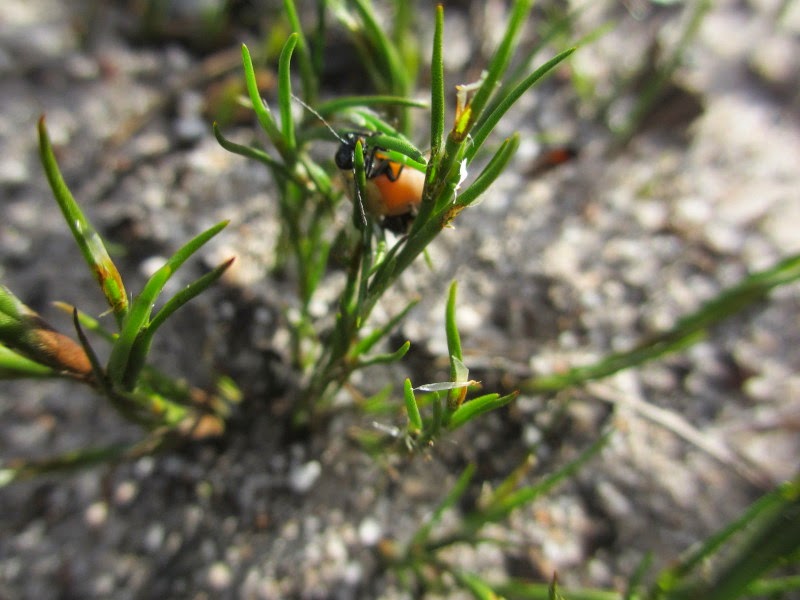
We're still finding plenty of Swollen Restio Beetles Pseudorupilia on the new growth of Restios, but not on any of the tufts of grass.

Swollen Restio Beetle Pseudorupilia

The densest stand we've found so far of Agapanthus walshii is coming along nicely!

Agapanthus walshii, doing well!

The Leucospermum oleifolium nearby is doing nothing yet.

Leucospermum oleifolium, no sign of life since the fire

What I'd hoped would be re-shooting at the base of the Heeria, is in fact Pelargonium!

Pelargoniums growing at the base of the burned Heeria

In places the Pelargoniums are coming up well!

Pelargoniums

Where the fire was hottest, the Palmiet has burned off completely and there's no sign of shooting. In other places, it's very encouraging.

Palmiet, recovering

We're still confused with the bushes we're seeing shooting from their bases. These leaves are in threes and are veined diagonally from the centre.

We had thought this might be Cape Myrtle but it's all wrong!

The burned remains of berries can be found.

Detail of a burned branch, with berries

New leaf detail:

Leaf detail, showing radiating veins

In many cases, these were saved from the worst of the fire's heat by their growing next to or between rocks. Here's another:

Another similar plant

How lucky we are to live here!

Eikenhof Dam and Groenlandberg

We found just two Tritoniopsis lata today, but what's that behind?  

Tritoniopsis lata

We were able to have a good look at the leaves here, definitely multi-ribbed:

Leaf detail

What might this be, next to an Oxalis?

What are these leaves?

We found several Fire Asparagus Asparagus Lignosus, this one's berries have turned dark:

Asparagus lignosus with dark berries

Others are still green.

Asparagus lignosus with still-green berries

And some are still in flower:

Asparagus lignosus in flower still

This gives an idea of how densely they sometimes grow!

Dense stand of Asparagus lignosus

'Till next time, from the Wurm.....

Wurm on the alert

.... and the Boy, who was determined to get in the pictures, every time!

I want to be in this picture!

:-) A


Sunday, 1 March 2015

Fire Lily Sunday Flower Walk

We were warned by Pat that we'd only have to wait two weeks after the fire for the Fire Lilies Cyrtanthus ventricosa to come up. Well it's only a week and a half and they're out, literally all over!

Fire Lily Cyrtanthus ventricosa

This below is the group next to the cycle path which we've known about for several years. I've moved the path away from them gradually over the years, but now that a stump opposite them has burned away, I've been able to kick away at the upper bank and pack more stones around these on the lower edge to protect them. There was no sign of these this time last week, I looked!

The group of Cyrtanthus ventricosa we've been protecting for years!

But this one is right in the middle of the cycle-path a short distance away!

Lone Cyrtanthus ventricosa in the middle of the cycle track!

Not surprisingly, the other one we have known about and had marked with a ring of stones, has also come up:

This is the other one we knew about and marked with a ring of stones

The fire is not out yet..... fanned by a brisk South-easter.

Fire still burning after a week and a half.

These burning stumps can throw up burning embers in this brisk South-easter and spread into unburned areas. But they are being watched by the tireless Working on Fire staff!

Working on Fire staff still on duty!

Otherwise, the regeneration is spectacularly quick in some cases as with this Restio:

Restio recovering quickly!

Another Restio was interesting, possibly an Elegia persistens. It had partly burned and fallen flat on the ground:

Elegia persistens (?) collapsed but spreading seeds

Yet all around, seed-heads had been blown into the now nutrient-rich holes of burned-out stumps:

Seed in hole from burned stump

... and:

Another....

.... and:

And another!

The Ways of Nature! At about this stage, we were treated to an aerial display of Formation Flying by two raptors, too far away for us to identify, and not looking like our normal Yellow-billed Kites or Jackal Buzzards. I captured a few seconds of their flight on this link: http://youtu.be/GOmIAgvuizs
I went to look at the remains of the Leucospermum oleifolium which we found recently.

Burned-out Leucospermum oleifolium

A bit sad to see, yet the flowers were interesting. There had been many spent flowers lying under the bush which I commented on, those are dispersed or burned, but those still on the bush look as if they will set seeds and disperse them. Comments, please!

But look at the flower!

This is the burned-out Cape Rockwood Heeria argentea we found at the same time. We will be watching it, but this shows it growing in rocks as Dominic said he normally finds them!

Burned out Cape Rockwood Heeria argentea

We walked on beyond the burned area.......

The far edge of the fire

The first unburned beauty we found was a Protea cynaroides, in bud now.

King Protea Protea cynaroides in bud

We crossed a stream, still just flowing at this time of the year completely overgrown with the shrub which Jennetta kindly identified, Water White Alder Brachylaena neriifolia, all in flower. They are said to like river valleys, these do!

Water White Alder Brachylaena neriifolia growing happily in a ravine

On the other side, we were treated to a completely different mix of Ericas from our normal stamping ground, yet we were only 500 metres beyond!

Unknown Erica

Flower detail:

Flower detail

Another:

Another unknown Erica

The flower looks like Erica pulchella, but the rest of the plant doesn't!

Its flowers

This one with round urn-shaped flowers:

Another 'new' Erica

Closer up:

Flower detail

This one has longer flowers:

Another unknown pink Erica with longer flowers

Flower detail:

Flower detail

On the way back, we recognised the burned out pink 'Helichrysum' Phaenocoma prolifera, even like this, it's impressive. Even burned, it's beautiful!

Burned out Phaenocoma prolifera

We walk back through the Experimental Farm. Not sure what Experiments they are doing besides perhaps seeing how many Codling Moths can live in one apple, but it's grossly unfair that this can be found on a Government Institution, next to a commercial orchard!

Codling Moth on Golden Delicious on Experimental Farm

Back at home, the March Lilies are looking splendid! There are more coming up!

March Lilies Amaryllis belladonna

:-) A


This email is free from viruses and malware because avast! Antivirus protection is active.